24/7 Emergency Line: 954-479-2040


The Role of Tow Trucks in Emergency Roadside Assistance & Safety
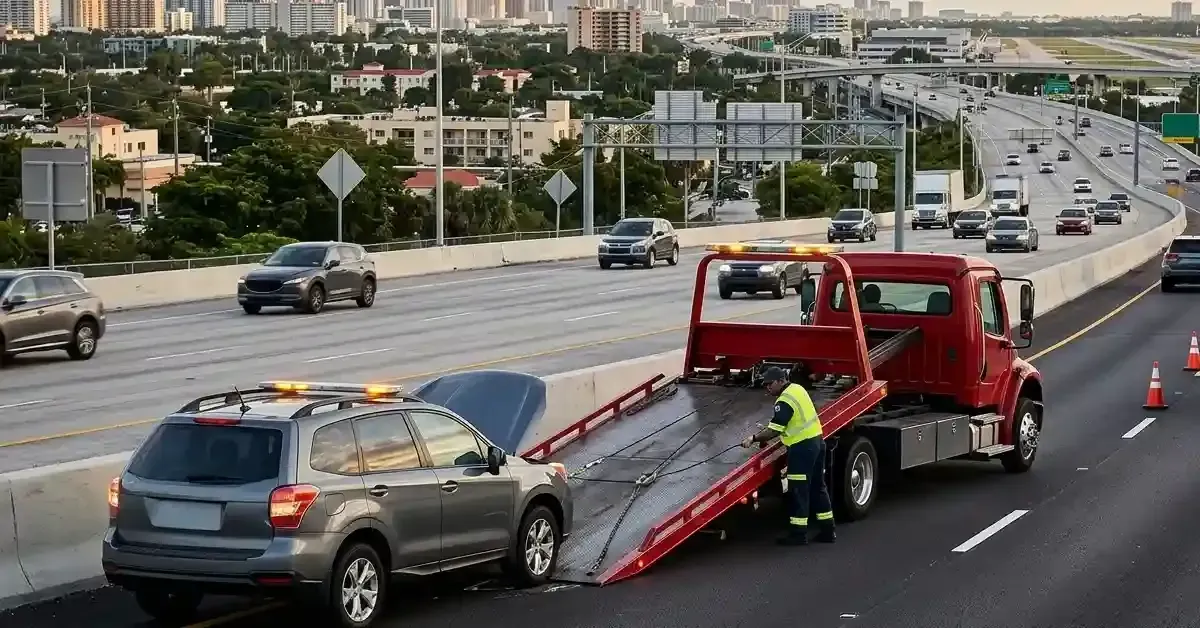
Emergency roadside assistance helps drivers deal with vehicle breakdowns, accidents, and other situations that make continued travel difficult or unsafe. Tow trucks are part of this response by assisting stranded motorists, recovering disabled vehicles, transporting damaged vehicles, and helping clear hazardous roadway incidents. By providing rapid operational intervention, specialized recovery equipment, and safe vehicle transport, tow trucks serve as a critical bridge between an unexpected vehicle failure and the restoration of normal travel.
What Role Do Tow Trucks Play in Emergency Roadside Assistance?
Tow trucks play a multifunctional role in emergency roadside assistance by addressing both the immediate safety needs of the driver and the logistical challenges of a disabled automobile. When a vehicle suffers a mechanical malfunction, structural collision damage, or operational failure, specialized towing equipment provides the necessary physical intervention to resolve the roadway obstruction.
The main roles of tow trucks in emergency roadside assistance include:
Assisting Stranded Vehicles
Recovering Disabled Vehicles
Transporting Damaged Vehicles
Clearing Hazardous Roadway Incidents
Improving Road Safety
Assisting Stranded Vehicles
Tow trucks assist stranded vehicles due to a breakdown or roadside emergency. While tow trucks are frequently associated with complete vehicle transport, they also serve as mobile response units for minor mechanical or operational failures that occur on shoulders, parking lots, and active travel lanes.
Roadside support from a tow truck operator addresses a wide variety of immediate issues, including:
Flat Tires: Replacing a punctured or blown tire with the vehicle's spare.
Dead Batteries: Providing jump-start assistance to restore electrical power to a depleted battery.
Empty Fuel Tanks: Delivering emergency fuel to enable the driver to reach the nearest service station.
Vehicle Lockouts: Deploying specialized entry tools to safely unlock passenger compartments when keys are trapped inside.
Mechanical Breakdowns: Performing basic diagnostic checks to determine if a vehicle can be safely driven or if it must be towed to a service facility.
Not all roadside events require moving the car to a repair facility. If a problem—such as an empty fuel tank or a flat tire—can be resolved on-site, the tow truck operator provides direct roadside assistance, allowing the motorist to resume travel without additional delay. However, when roadside repairs cannot safely resolve the failure, the driver's needs transition from basic assistance to formal vehicle recovery.
Recovering Disabled Vehicles
Tow trucks recover disabled vehicles when a mechanical failure, severe collision damage, or an off-road excursion prevents a car from moving under its own power. A disabled vehicle refers to any automobile that is physically or mechanically incapable of safe operation on public roadways. This includes vehicles stranded in ditches, submerged in mud, trapped in snow, or positioned precariously on highway embankments.
When basic roadside assistance is insufficient to restore mobility, physical vehicle recovery becomes mandatory. Tow truck operators deploy specialized recovery gear—including hydraulic winches, steel cables, snatch blocks, and wheel-lift assemblies—to extract cars from difficult off-road locations without causing structural frame stress. Once a disabled vehicle is winched back onto a flat surface or raised off its axles, it is safely positioned for loading, transitioning the operation from initial recovery to safe transportation.
Transporting Damaged Vehicles
Tow trucks transport damaged vehicles after they have been successfully recovered from an accident location. Unlike initial recovery—which focuses on physically extracting or moving a car away from an immediate hazard—transportation involves securing the vehicle onto a tow rig and hauling it to a designated destination, such as an auto body shop, mechanical repair facility, insurance inspection yard, or secure storage facility.
Transporting automobiles damaged by severe collisions or major mechanical failures requires specific equipment selection to prevent additional damage during transit. For example, vehicles with compromised wheel suspensions, missing axles, or frame damage cannot be safely towed using traditional wheel-lift systems. In these instances, flatbed tow trucks (roll-backs) are utilized to carry the entire weight of the damaged vehicle on an elevated platform. Securing the automobile using heavy-duty nylon straps or chains attached to the frame ensures that the vehicle remains immobile during highway transit.
Clearing Hazardous Roadway Incidents
Tow trucks help clear hazardous roadway incidents by removing disabled or damaged vehicles that obstruct traffic or create additional risks for motorist and emergency responders. An immobile car left in an active travel lane, near a sharp curve, or on a narrow highway shoulder represents an immediate hazard that can trigger secondary multi-vehicle collisions.
Improving Road Safety
Tow trucks improve road safety by removing disabled automobiles from active traffic corridors, tow truck operators reopen closed lanes, relieve traffic congestion, and protect both stranded drivers and oncoming traffic from potential collisions. Furthermore, clearing the scene enables police, fire, and emergency medical services (EMS) to maintain unhindered access to emergency locations.
These items provide essential sustenance and environmental protection during extended wait times for roadside assistance. A heavy blanket prevents hypothermia during cold-weather breakdowns when engine heat is unavailable, while bottled water ensures hydration, particularly during high-temperature summer vehicle stalls in South Florida.
What Services Do Tow Trucks Provide During Roadside Emergencies?
Beyond complete vehicle transport, tow trucks act as versatile mobile workshops equipped to resolve a wide array of emergency roadside conditions.
Flat Tire Assistance: Tow truck operators provide flat tire assistance by removing damaged tires and mounting the vehicle's functional spare tire on-site. If the vehicle lacks a usable spare tire, or if multiple tires are damaged simultaneously due to severe road debris or a curb impact, on-site replacement becomes impossible. In these scenarios, the tow truck operator transitions to towing the vehicle directly to a tire center or repair facility.
Dead Battery Assistance: Dead battery assistance involves applying external electrical current via high-output portable jump-starter packs or heavy-duty onboard boost cables to start a vehicle with a depleted battery. Cold weather, alternator failures, or parasitic electrical draws frequently leave batteries discharged. If a jump-start fails to engage the starter motor—indicating a failed alternator, bad starter, or blown fuse—a tow truck is used to transport the car for electrical diagnostic repairs.
Fuel Delivery: When a vehicle runs completely out of fuel, tow trucks supply emergency fuel delivery (typically 2 to 5 gallons of gasoline or diesel) directly to the stranded vehicle's location. This quantity provides sufficient fuel for the motorist to safely drive to the nearest gas station. If the vehicle fails to start after fuel delivery due to air stuck in the fuel lines or a burnt-out fuel pump, towing becomes necessary.
Vehicle Lockout Assistance: Vehicle lockout assistance utilizes specialized, non-destructive lock-entry tools—such as inflatable door wedges, long-reach tools, and precision lock picks—to gain access to a vehicle when keys are locked inside. If an electronic lock mechanism malfunctions or key fob programming fails completely, the vehicle must be loaded onto a tow truck and transported to a dealership or automotive locksmith.
Winch-Out Recovery: Winching services employ heavy-duty steel or synthetic cables driven by hydraulic or electric winches to pull vehicles out of precarious off-road locations. Common winch-out scenarios include a vehicle stuck in mud, sand, flood, or snow.
How Tow Trucks Support Accident and Collision Response?
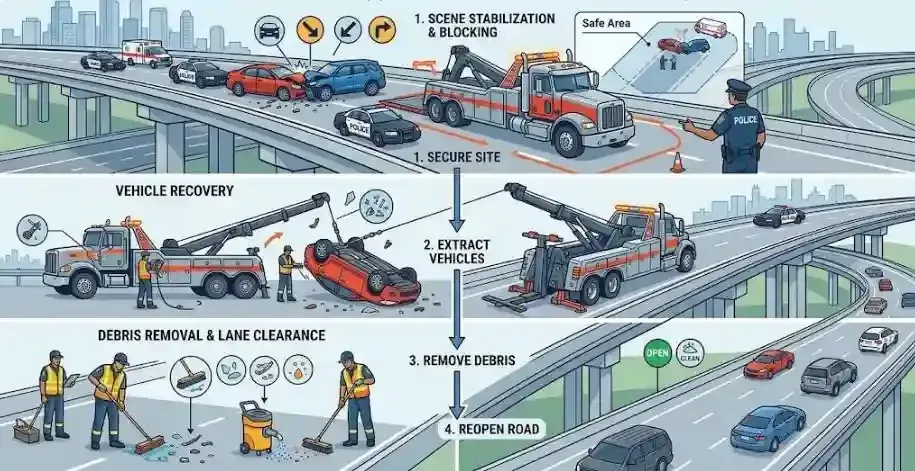
Accidents and structural collisions require precise coordination between towing personnel, law enforcement agencies, and municipal emergency services. Tow trucks support accident and collision response by:
Removing Disabled Vehicles From Accident Scene
Following a vehicular collision, disabled cars frequently block active travel lanes, littered with broken glass, fluids, and structural debris. Tow trucks respond to accident scenes to clear these disabled vehicles, eliminating physical hazards and allowing municipal clean-up crews or emergency services to restore normal traffic operations.
Recovering Damaged Vehicles Safely
Recovering collision-damaged automobiles requires deliberate equipment selection, precise loading protocols, and careful tie-down procedures to ensure safe transport:
| Recovery Step | Operational Process | Used Equipment |
|---|---|---|
| 1. Equipment Selection | Assessing vehicle damage, weight class, and drive layout to determine the correct tow rig. | Flatbed / Wheel-Lift / Heavy-Duty Rig |
| 2. Vehicle Loading | Guiding or winching the damaged vehicle onto the bed or lift arm without inflicting secondary damage. | Hydraulic Winch, Snatch Blocks, Skids |
| 3. Securing the Load | Fastening the vehicle to the tow platform at multiple structural anchor points. | Nylon Wheel Straps, Safety Chains |
| 4. Transportation | Transporting the vehicle via approved transit routes to a repair or storage facility. | Flatbed Platform, Heavy Tow Assembly |
Helping Restore Traffic
A single disabled vehicle on a busy highway can cause miles of backed-up traffic within minutes. Rapid vehicle extraction by tow truck operators reopens blocked lanes, restores normal traffic velocity, and prevents severe traffic delays following an accident scene clearance.
Supporting Emergency Responders
Tow truck operators work directly alongside police officers, firefighters, and paramedics at crash sites. While medical personnel treat injuries and police document the scene, tow operators prepare the damaged vehicles for immediate removal as soon as law enforcement releases the scene, ensuring the safety of all on-site personnel.
How Tow Trucks Improve Road Safety During Emergencies?
Vehicle breakdowns on active roadways pose serious safety hazards to all nearby drivers. Tow trucks serve as a core defensive component of modern traffic management by actively mitigating these hazards.
Removing Roadside Hazards
A stationary vehicle sitting in a lane or on a narrow shoulder acts as an unexpected physical barrier. Promptly removing these stationary hazards eliminates potential crash obstacles for approaching drivers.
Protect Stranded Drivers
Stranded motorists standing near active traffic lanes are exposed to passing vehicles traveling at high speeds. Tow truck operators provide immediate protection by using their heavy vehicles equipped with high-visibility amber strobe lights and directional light bars to create a physical barrier between traffic and the stranded driver.
Reducing Exposure to Passing Traffic
The longer a driver remains stopped on the side of a highway, the higher their statistical probability of being involved in a secondary crash. Tow trucks reduce this dangerous exposure time by quickly repairing or loading the vehicle and transporting the motorist to a safe location.
Helping Prevent Secondary Accidents
Secondary crashes occur when passing drivers swerve, slow down abruptly, or fail to notice a stopped vehicle or emergency scene ahead. By clearing incidents rapidly and deploying high-visibility warning lights, tow trucks reduce driver distractions and lower the likelihood of secondary collisions.
Restoring Traffic Flow
A disabled vehicle left on an active highway shoulder can cause rubbernecking and dangerous traffic deceleration. Rapid vehicle removal by tow trucks reopens restricted lanes and restores uniform traffic speeds, lowering overall roadway risk.
What Types of Tow Trucks Respond to Emergency Roadside Assistance?
Different emergency situations require specific towing apparatus to match the vehicle size, drive configuration, and damage level. The most common types of tow trucks that respond to emergency roadside assistance include:
Flatbed Tow Trucks: Also known as roll-backs—feature a hydraulically operated bed that tilts and slides down to ground level. The vehicle is either driven onto the bed or pulled up using an electric or hydraulic winch. Once loaded, the bed lowers to a horizontal position for transit. Flatbeds are ideal for four-wheel-drive (4WD/AWD) vehicles, luxury cars, low-clearance vehicles, and severely damaged crash units because all four wheels remain entirely off the ground during transport.
Wheel-Lift Tow Trucks: Wheel-lift tow trucks use a heavy metal yoke that slides under either the front or rear tires of a vehicle. A hydraulic hoist lifts that end of the automobile off the ground, leaving the remaining two wheels rolling on the road. Wheel-lift trucks are highly maneuverable, making them ideal for tight spaces, such as parking garages, narrow city streets, and light-duty front-wheel-drive towing.
Heavy-Duty Tow Trucks: Heavy-duty tow trucks are built with reinforced chassis, multi-axle configurations, integrated boom lifts, and high-capacity hydraulic winches. These rigs are engineered specifically to recover and transport large commercial vehicles, including semi-trucks, tractor-trailers, buses, motorhomes, and heavy construction equipment.
What Should Drivers Do Before Tow Truck Arrives?
Taking the proper safety steps while waiting for a tow truck minimizes personal danger and speeds up vehicle recovery upon the operator's arrival.
Move Vehicle to a Safe Location: If the car is still mobile, slowly drive it off the road onto the far-right shoulder, an exit ramp, or a nearby parking lot.
Turn on Hazard Lights: Instantly activate your emergency flashers to alert oncoming drivers that your vehicle is stopped.
Avoid Standing in Active Traffic: Never stand directly behind or in front of a stopped vehicle on a highway. If safe to do so, exit through the passenger door away from live traffic and stand behind a highway guardrail or up an embankment.
Contact Emergency Services When There Is Immediate Danger: Call 911 immediately if your vehicle is stalled in a live lane, on a blind curve, or if passing traffic makes exiting the car impossible.
Provide Accurate Location and Vehicle Information: Share exact GPS location details, highway mile markers, cross streets, and your vehicle's make, model, and color with the dispatch operator.
What Happens When You Call for A Roadside Assistance Service?
When you call for a roadside assistance service, the following process triggers:
1. Requesting Assistance
Driver calls provider; gives location and problem details
2. Assessing Vehicle Problem
Dispatcher determines if issue needs roadside fix or towing
3. Dispatching Appropriate Tow Truck
Selects flatbed, wheel-lift, or heavy rig based on need
4. Recovering or Assisting Vehicle
Operator arrives, sets up safety zones, fixes or winches car
5. Transporting Vehicle When Needed
Damaged car is secured and hauled to repair facility
6. Completing Roadway Clearance
Hazard is removed; traffic lanes reopened safely
Why Professional Roadside Assistance Matters?
Relying on professional roadside assistance ensures vehicle recovery is conducted safely, minimizing physical damage and protecting motorists. A professional roadside assistance company provides:
Appropriate Recovery Equipment: Professional companies utilize purpose-built tow rigs rated for specific vehicle weights, preventing drive-train or frame damage during extraction.
Safe Vehicle Loading and Transport: Trained operators follow standardized rigging, winching, and wheel-strapping protocols to keep vehicles firmly secured during high-speed highway transport.
Operator Awareness at Roadside Scenes: Experienced operators understand traffic management, positioning tow rigs to shield working areas and using high-visibility safety gear to operate safely near high-speed lanes.
Faster Removal of Roadway Obstructions: Commercial towing equipment allows for rapid vehicle clearance, opening blocked lanes promptly.
Frequently Asked Questions
What does a tow truck do during an emergency?
During an emergency, a tow truck assists stranded drivers, performs on-site fixes like jump-starts or tire changes, stuck winches or off-road vehicles back to safety, transports damaged cars to repair shops, and clears vehicle wreckage from active traffic lanes to keep highways safe.
How do tow trucks help after an accident?
After an accident, tow trucks extract damaged vehicles from the crash site, clear broken car parts and dangerous debris from the street, haul disabled cars to body shops or storage lots, and reopen blocked lanes for traffic.
Do tow trucks work with police and emergency responders?
Yes, tow truck companies work closely with police officers, firefighters, and paramedics. They are dispatched by local authorities to clear accident scenes, move vehicles blocking emergency routes, and restore normal traffic flow once investigations are complete.
How do tow trucks help improve roadway safety?
Tow trucks improve roadway safety by rapidly removing stalled or crashed vehicles from active travel lanes, protecting stranded drivers with high-visibility warning lights, preventing secondary rear-end collisions, and eliminating dangerous roadside hazards.
Baptiste Towing & Transport provides 24/7 towing, flatbed transport, vehicle recovery, and roadside assistance across Broward, Miami-Dade, and Palm Beach Counties.
COMPANY
FOLLOW US
© 2026. Baptiste Towing and Transport LLC. All Rights Reserved.