How to Safely Wait for a Tow Truck: Emergency Roadside Safety Guide
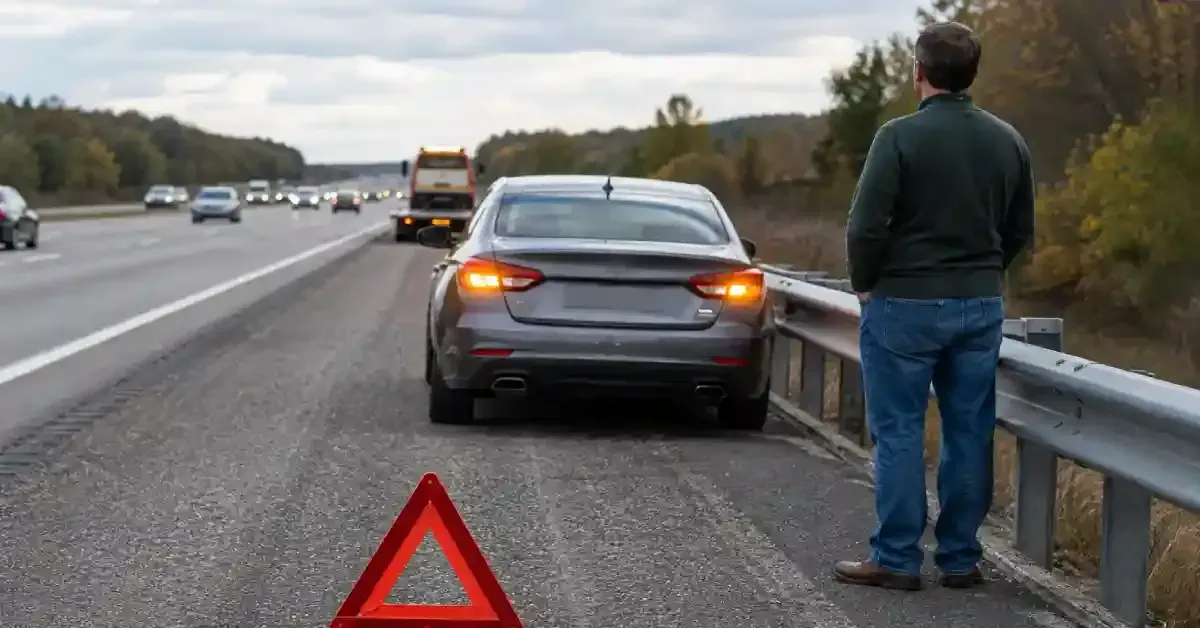
Staying safe while waiting for a tow truck requires immediately steering the vehicle off active traffic lanes, signaling your location to passing motorists with hazard lights and reflective devices, and contacting authorized dispatchers with precise location telemetry. Taking these precautionary measures during a roadside wait ensures physical safety, prevents secondary accidents, and streamlines professional recovery operations.
How to Stay Safe While Waiting for Tow Truck?
To stay safe while waiting for a tow truck, follow the tips mentioned below:
Pull over to a safe location
Make your vehilce visible by turning on the hazard lights
Keep important items like car keys, phone, wallet, etc with you
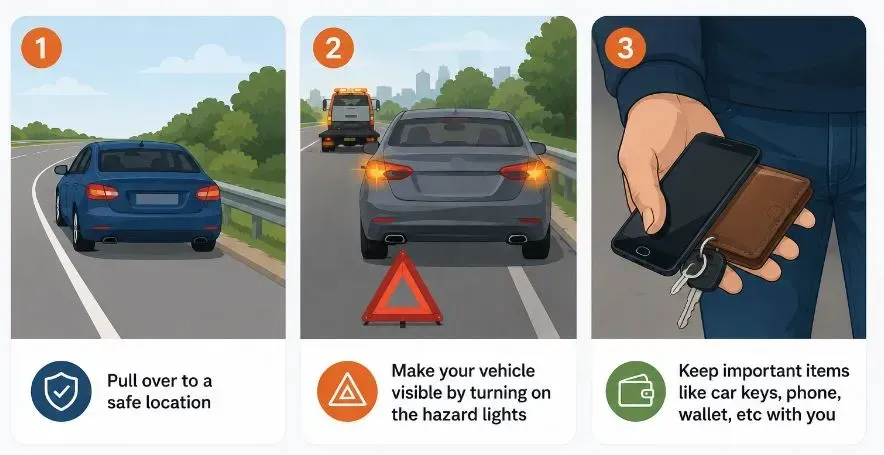
Pull Over to A Safe Location
Pulling over to a safe location means moving as far right as possible, ideally past the shoulder line and onto flat, stable ground. A breakdown lane, exit ramp, or parking lot works better than a narrow shoulder on a high-speed road, if reaching one is possible without further risk.
Avoid stopping on a curve, near a hill crest, or in a low-visibility spot, since oncoming traffic needs enough distance to see and react to a stopped vehicle.
Engage the parking brake immediately after stopping. Turn the front tires toward the outer guardrail or curb if parked on a slope. Turning the wheels prevents the car from rolling into active traffic lanes if struck from behind. Position the vehicle as far away from the active fog line as possible.
Make Your Vehicle Visible: Using Hazard Lights and Warning Devices
Making your vehicle visible starts with hazard lights, turned on the moment you realize you need to stop. This single action cuts your risk of a secondary collision more than almost anything else you can do in the first 10 seconds.
Warning triangles or road flares add a second layer of visibility, placed roughly 100 feet behind the vehicle if you can do so safely. Keep these in your trunk permanently, since a breakdown is the wrong moment to discover you don't own any.
| Visibility Tool | Recommended Distance Behind Vehicle | Primary Function | Ideal Environmental Condition |
|---|---|---|---|
| Hazard Lights | Integrated on vehicle | Alerts nearby drivers via flashing amber lights | All breakdown scenarios |
| Reflective Triangles | 100 to 200 feet | Reflects headlight beams in low-visibility conditions | Nighttime and overcast weather |
| Road Flares / LED Beacons | 100 to 200 feet | Emits active light signals during night roadside emergencies | Dense fog, heavy rain, or severe night darkness |
Take Important Items With You
Taking important items with you means grabbing your phone, wallet, identification, and any medication before stepping out, especially if you plan to wait outside or away from the vehicle. Leaving these behind means a second, riskier trip back to a vehicle sitting in an active traffic lane. Remove valuable electronics and wallets from plain sight. Keep key fobs secured on your person during standard roadside waits.
What Details to Share When Calling A Tow Truck Company?
Once you secure yourself and your vehicle, it's time to share the valuable details by calling your local tow company.
Communicate Your Exact Location Clearly
Communicating your location clearly means giving the nearest mile marker, exit number, or cross street, rather than a vague description like "on the highway near the mall." GPS coordinates from your phone's map app add precision a dispatcher can use directly, especially on long, featureless stretches of highway.
The details to provide dispatch include your exact location, vehicle make and model, the nature of the problem, and whether anyone is in immediate danger. Mentioning specific hazards, like a steep shoulder drop-off or heavy traffic, helps the responding driver prepare before arrival.
Vehicle Details & Current Scenario
Provide vehicle make and model, the nature of the problem, and whether anyone is in immediate danger. Mentioning specific hazards, like a steep shoulder drop-off or heavy traffic, helps the responding driver prepare before arrival.
Should You Stay Inside or Outside the Vehicle While Waiting for Tow Truck?
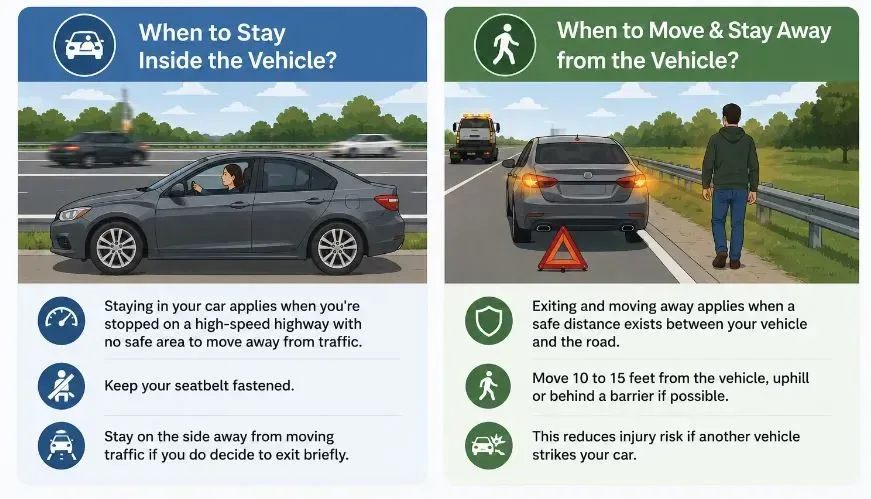
Whether to stay inside or outside your vehicle depends on your exact location and the speed of surrounding traffic. This decision carries real safety weight, and it shifts based on a few specific factors.
See the image below for a better understanding when to sit inside a vehicle and when to stay away from it.
What Should You Do While Waiting for A Tow Truck?
While waiting for the tow truck, staying alert and choosing the right provider both matter, since this waiting period is when most of the actual risk exists.
Stay Alert and Aware of Your Surroundings: Staying alert and aware of your surroundings means watching approaching traffic, keeping your phone accessible, and avoiding distractions like scrolling through unrelated apps. Awareness during this window matters more than at almost any other point in the process, since you're stationary in an environment built for moving vehicles.
Get Prepared: Pull out your driving license, vehicle registeration, and car insurance certificate. Keep your valuable items such phone, wallet, etc with you.
Avoid: Do not keep yourself close to the fast traffic lanes. Avoid fixing your car as help is already on the way to get you out of trouble.
What to Do When The Tow Truck Finally Arrives?
Below are the steps to follow when the tow truck finally shows up at your location:
Preparing Vehicle for the Tow: Follow the tow operator's instructions for shifting into "Neutral", releasing the parking brake if requested, and staying clear of the vehicle during hook-up or loading. Standing well back during this process protects you from moving equipment and cables under tension. Take out the important things such as keys, wallet, or keys before the operator lifts your vehicle.
Verify the Truck & Driver : Verifying tow operator credentials means asking for the towing license, a company ID or uniform, and confirmation that the driver's name matches what dispatch provided. This step takes under a minute and directly protects against the rare but real risk of an unauthorized tow. Make sure the towing company has good local reputation and uses professional equipment to tow your vehicle to the desired location.
Confirm Cost & Destination: Always confirm the towing cost and final destination where you want the vehicle to be towed.
FAQs
What is the average time for a tow truck to arrive?
The average time it takes for a tow truck to arrive falls between 30 and 60 minutes for a standard breakdown, when the dispatcher confirms the vehicle's exact location quickly and the call gets treated with normal priority.
What should I do If my phone battery dies while waiting for a tow truck?
If your phone battery dies while waiting, flag down a passing driver or use a roadside emergency call box if one is nearby, common on many highways. Keeping a portable phone charger in your vehicle at all times prevents this situation from happening in the first place.
Can I leave my car while waiting for a tow truck?
Yes, you may leave your car while waiting for a tow truck only if you at a safe location. Make sure you vehicle is parked on a shoulder or location away from the moving traffic. Turn on the hazard lights or place reflective triangle behind your vehicle to aware the incoming traffic about your situation.
Should I keep the car engine running while waiting for a tow truck?
Keeping your vehicle engine running while you wait is safe on a clear roadside, but dangerous if snow, mud, or debris blocks the exhaust pipe. A blocked exhaust can allow carbon monoxide to build up inside the vehicle, so check that the tailpipe stays clear if you keep the engine on for heat or air conditioning.
Should children or pets stay inside the vehicle while waiting for a tow truck?
Children and pets should generally stay inside the vehicle while you wait, buckled or secured as normal, rather than standing near an active roadway. If the vehicle sits in a genuinely unsafe spot with no shoulder space, move everyone together to a safe area away from traffic instead of leaving anyone alone in either location.
What to do if another vehilce nearly hits me while waiting for a tow truck?
If another vehicle nearly hits you while waiting, move further from the roadway immediately, even if that means standing farther from your own vehicle than usual. A near-miss is a direct signal that your current position isn't as safe as it seemed, and adjusting immediately matters more than staying close to your car.
Baptiste Towing & Transport provides 24/7 towing, flatbed transport, vehicle recovery, and roadside assistance across Broward, Miami-Dade, and Palm Beach Counties.
COMPANY
FOLLOW US


© 2026. Baptiste Towing and Transport LLC. All Rights Reserved.