24/7 Emergency Line: 954-479-2040



What to Do If EV Runs Out of Charge? Steps to Take Immediately
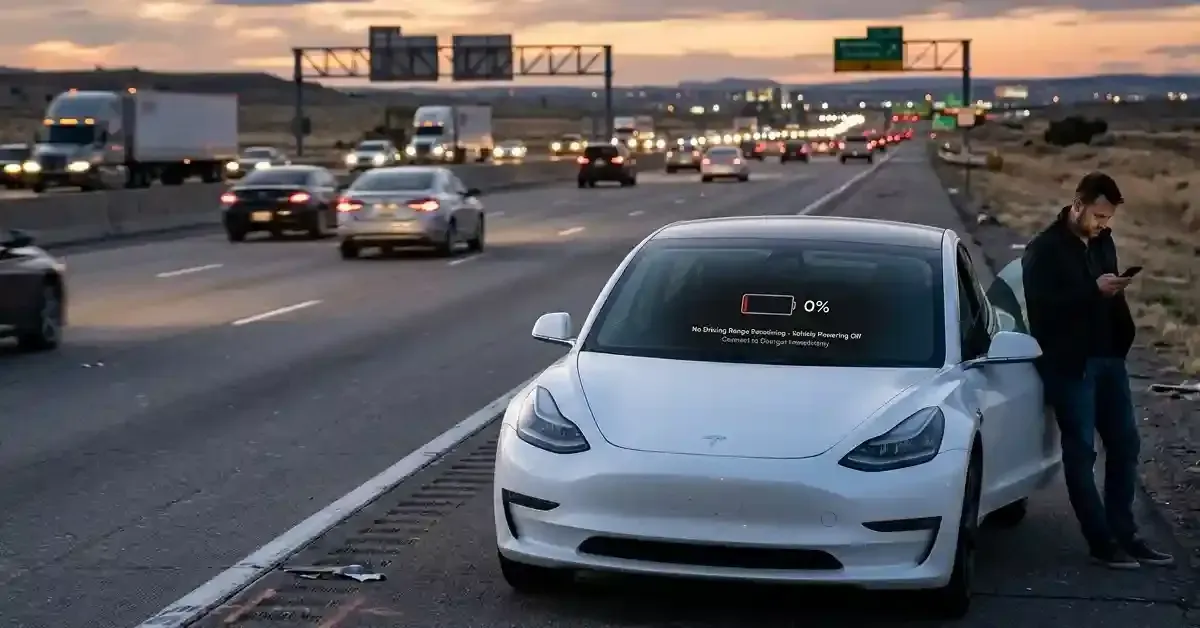
Whether you drive a Tesla, Nissan Leaf, Toyota bZ4X, or any battery-powered vehicle, a depleted battery can leave you stranded and uncertain on a highway. Modern EVs provide drivers with real-time battery monitoring, range estimates, and low-charge warnings that help reduce the risk of becoming immobilized. Knowing what to do when an EV runs out of charge is essential for maintaining safety, minimizing disruption, and restoring mobility as quickly as possible. When an electric vehicle loses power completely, steer the vehicle smoothly onto a safe shoulder, engage the hazard warning lights, set the parking brake, and contact a roadside assistance provider for mobile charging or flatbed tow truck transport. This guide explains what happens when an EV battery is depleted, the immediate actions to take, the recovery options available, and the useful tips that can help prevent running out of charge on an EV.
What Actually Happens If EV Runs Out of Charge?
When an electric vehicle (EV) is about to run out of charge, it triggers multiple warnings to the driver. Most EVs are designed to provide multiple alerts and dashboard notifications that give drivers time to take corrective action before the battery reaches 0%. Understanding these warning signs can help you respond appropriately and avoid becoming stranded.
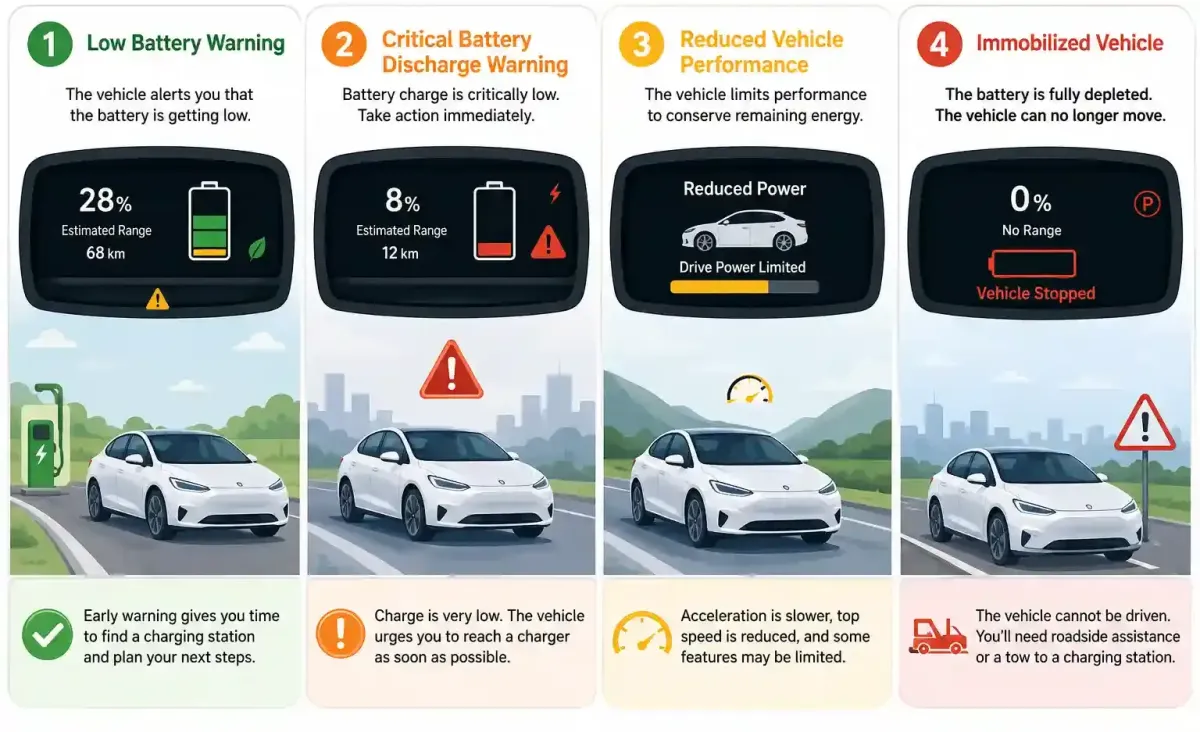
Low Battery Warning: Most EVs generate a low battery warning long before the battery reaches a critical level. Depending on the vehicle, the dashboard may display a notification, battery icon, audible alert, or charging recommendation. These early warnings are designed to give drivers time to locate a charging station, adjust their route, or prepare for a charging stop before the remaining range becomes limited.
Critical Battery Discharge Warning: As the battery continues to discharge, the vehicle typically displays more urgent dashboard indications. Drivers may see the battery percentage approaching 0%, flashing battery symbols, critical charge notifications, or messages advising them to charge immediately. These warning signs indicate that the available energy reserve is becoming depleted and that immediate action may be necessary to avoid losing mobility.
Reduced Vehicle Performance: Many EVs automatically enter a reduced performance mode when battery levels become critically low. To conserve energy, the vehicle may limit acceleration, reduce power output, restrict certain driving modes, or lower overall performance. These adjustments help extend the remaining range and increase the likelihood of reaching a nearby charging location before the battery is fully depleted.
Immobilized Vehicle: Once the battery reaches a fully depleted state, the EV can no longer power the electric motor and becomes immobilized. The vehicle effectively becomes a disabled vehicle that cannot continue under its own power. At this point, drivers should focus on safety, move the vehicle out of traffic if possible, and arrange appropriate assistance.
What Are The Immediate Steps to Take If EV Runs Out of Charge?
If an electric vehicle reaches zero charge, execute these immediate recovery steps to secure the vehicle and arrange safe transport:
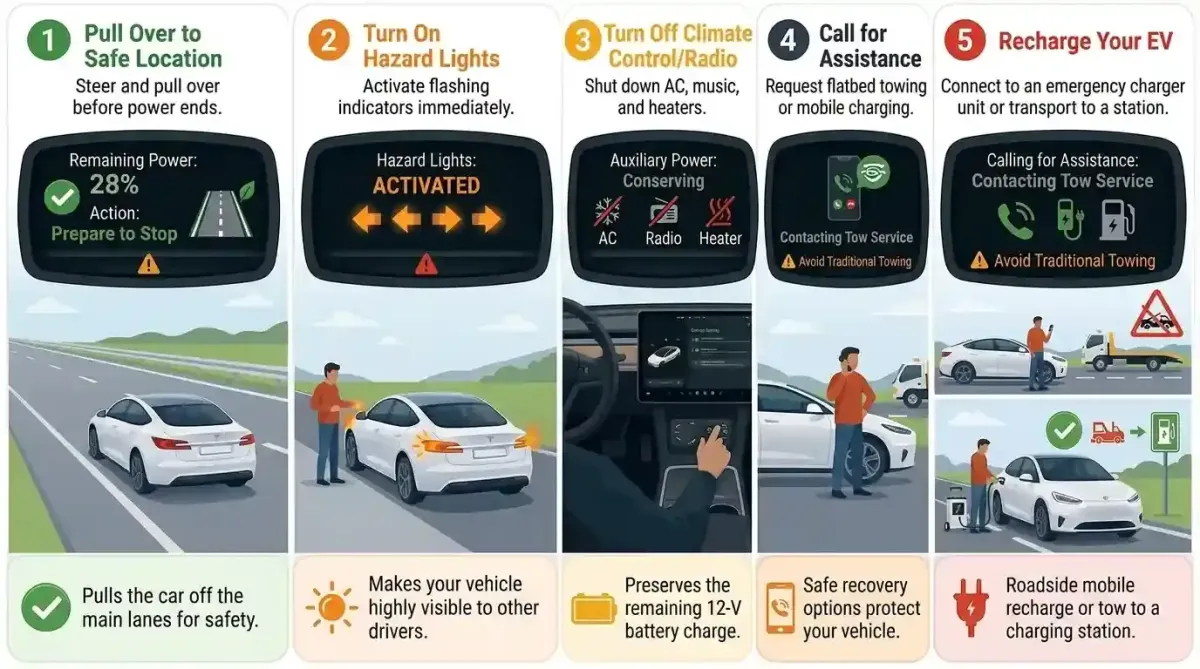
Step 1: Pull Over to Safe Location
Steer the vehicle smoothly onto a paved road shoulder, emergency turnout, or off-street parking area while active power-steering assistance remains functional. Securing a safe location off active traffic lanes prevents rear-end collisions, provides a stable ground surface for winch loading, and creates clearance for flatbed ramp deployment.
Step 2: Turn on Hazard Lights
Activate the emergency hazard light switch to operate all exterior amber flashing indicators continuously. Flashing hazard lights alert oncoming traffic, establish visual awareness during nighttime breakdowns, and warn surrounding motorists of a stopped, unpowered vehicle.
Step 3: Turn off Climate Control/Radio
Shut down energy-draining cabin systems, including the AC compressor, blower fan, car music, radio, and main climate control units. Disabling these high-draw accessories eliminates parasitic load on the auxiliary system, preserving remaining voltage within the 12V auxiliary battery to power hazard flashers, digital dashboard displays, and electronic door locks.
Step 4: Call for Roadside Assistance
Contact an emergency service provider to request a specialized flatbed tow truck or a service truck equipped with a mobile emergency EV charger unit. Inform the dispatch agent that the vehicle has zero charge left and a flat 12-V battery, and explicitly instruct the operator to avoid traditional towing trucks to prevent permanent high-voltage inverter damage to the EV drive train from rolling tire friction.
Step 5: Recharge Your EV
Connect the electric vehicle to roadside mobile recharge EV equipment or transport the vehicle directly to a public charging facility. Roadside assistance operators utilize mobile DC or AC emergency charging units to supply emergency range on-site, or secure the vehicle on a flatbed carrier for transport to a Level 2 or Level 3 fast-charging hub.
What Drains An Electric Car Battery the Most?
The electric drive motor is the primary component responsible for draining the most power from an electric vehicle's high-voltage traction battery, accounting for up to 80% to 90% of total energy consumption during high-speed driving and heavy acceleration. Beyond mechanical propulsion, secondary electrical subsystems and environmental factors significantly accelerate high-voltage battery depletion.
An EV battery depletes due to:
Electric Drive Motor (Primary Consumption): Driving at sustained highway speeds, aggressive accelerating, and climbing steep elevations demand continuous high-amperage output from the high-voltage traction battery, serving as the single largest energy drain in the vehicle.
HVAC Climate Control System (Secondary Consumption): The electronic air conditioning compressor and cabin heater (resistive heating elements or heat pumps) draw substantial electrical power directly from the main battery pack, particularly when maintaining cabin temperatures in extreme ambient heat or freezing weather.
Aggressive Acceleration and High-Speed Cruising: Rapid throttle input forces maximum current discharge through the power inverter, while high aerodynamic drag at elevated speeds requires constant torque output from the drive motor.
Extreme Ambient Temperatures: High environmental heat and freezing conditions force thermal management systems to run liquid-cooling pumps and battery heaters continuously to keep internal lithium-ion cells within safe operational temperature limits.
How to Prevent Your EV Running Out of Charge?
Follow the tips below to prevent your EV running out of charge:
Plan Charging Stops: Long-distance driving requires mapping routes around fast-charging infrastructure. Select high-density corridors featuring Level 3 DC fast chargers, identifying primary stop options alongside secondary backup plugs spaced every 50 to 80 miles.
Monitor Esitmated Range: Rely primarily on state-of-charge (SoC) percentages rather than displayed mileage estimates. Real-time range algorithms recalculate dynamically based on driving aggression, elevation changes, and cabin climate settings. Treat 20% SoC as the functional baseline for seeking a charging station.
Understand Weather Impact: Ambient thermal conditions influence usable electrical capacity. Extreme heat demands elevated battery cooling workloads, while freezing cold increases internal resistance within lithium-ion chemistry. Plan for a 15% to 30% reduction in rated total range during severe seasonal weather extremes.
Use Route Planning Tools: Utilize specialized navigation platforms (such as A Better Routeplanner or integrated OEM navigation systems). These software suites calculate real-time energy usage by factoring in payload weight, ambient wind vector data, elevation changes, and live charger availability.
Keep Charging Backup: Store a portable Level 1/Level 2 emergency charging cord inside the vehicle trunk. Carrying adapter heads compatible with standard 120V household outlets and 240V NEMA outlets ensures access to electrical grid infrastructure during emergency stops.
Avoid Driving At Low Charge: Sustaining operational charge levels between 20% and 80% protects internal component longevity. Frequently draining lithium-ion battery cells below 5% accelerates mechanical stress, increases heat output during recharge cycles, and heightens the risk of unexpected roadside shut-offs.
Apply Regenerative Braking: Regenerative braking captures kinetic energy during deceleration and feeds it back into the high-voltage battery pack by reversing the electric motor, turning momentum into stored power rather than wasting it as friction heat. Beyond extending driving range by up to 15% in stop-and-go traffic, this process actively preserves the long-term health of the battery.
When Does a Stranded EV Require Emergency Roadside Towing?
A stranded electric vehicle requires emergency roadside towing under the following scenarios:
Inaccessibility to Mobile DC Charging Infrastructure: The vehicle is stranded in a remote, rural, or low-density area beyond the service boundary of mobile emergency charging fleets.
Distance Imbalance to the Nearest Public Charging Facility: The remaining or delivered temporary mobile charge (typically 5 to 10 miles of range) is insufficient to reach a functional Level 2 or Level 3 DC Fast Charging station.
High-Voltage Component or Mechanical Drivetrain Failure: The vehicle experiences a primary drive inverter failure, high-voltage battery cell imbalance, short circuit, or mechanical lockup beyond simple charge depletion.
Total 12V Auxiliary Battery Failure: The 12V auxiliary system is shorted or completely un-jumpable, preventing vehicle control modules from initializing, disengaging the electronic parking brake, or closing high-voltage contactors to accept a charge.
Can You Tow An Electric Vehicle?
Yes, you can tow an EV but it must be transported exclusively on a flatbed tow truck to keep all four wheels stationary, preventing regenerative braking current from damaging the electric drive train.
Can You Jump Start A Dead Electric Vehicle?
Yes, you can jump start a dead electric vehicle, but you are jump-starting exclusively the 12-V electric car’s auxiliary battery, never the high-voltage traction battery pack. An electric vehicle relies on a dual-battery system. While the primary high-voltage battery pack supplies mechanical drive power to the electric motors, the 12-V electric car’s auxiliary battery powers cabin electronics, safety sensors, hazard lights, digital displays, and high-voltage contactor relays.
Will Roadside Assistance Charge My EV On-Site?
No, the roadside assistance services transport stranded EVs directly to the nearest charging station on a flatbed, though select urban fleets offer mobile charging units.
Baptiste Towing & Transport provides 24/7 towing, flatbed transport, vehicle recovery, and roadside assistance across Broward, Miami-Dade, and Palm Beach Counties.
COMPANY
FOLLOW US
© 2026. Baptiste Towing and Transport LLC. All Rights Reserved.