What Is Roadside Assistance and When Should You Call For It?
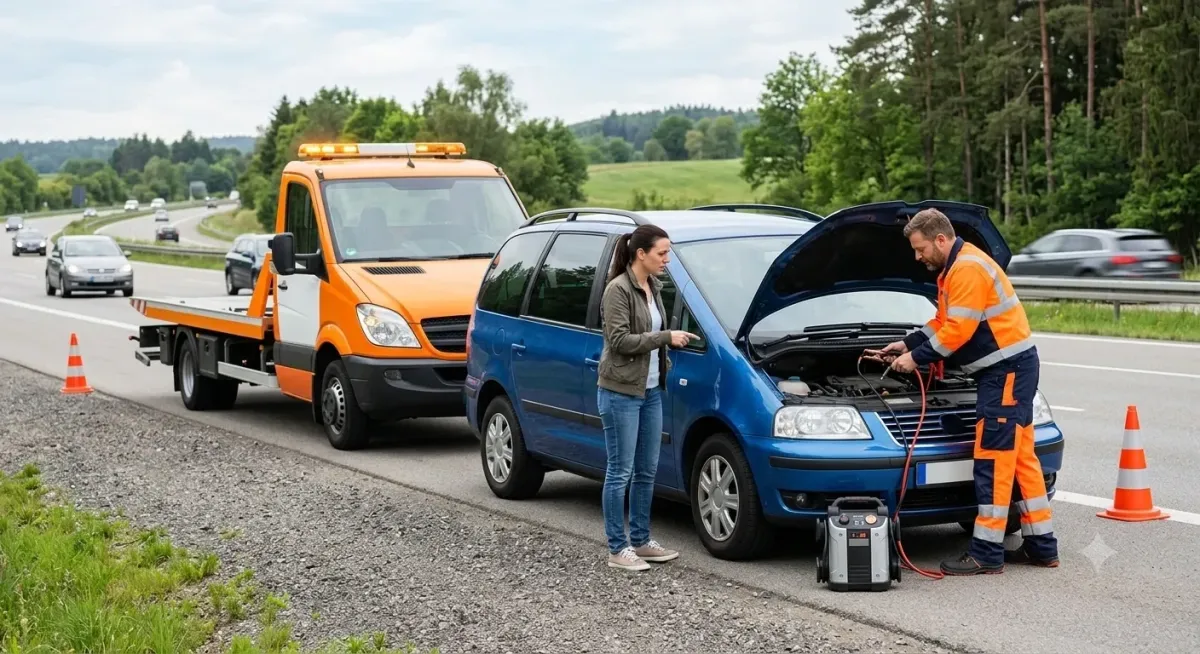
Getting stranded on the side of the road with a broken-down vehicle is a frustrating, stressful, and often dangerous situation. Whether you are dealing with a sudden flat tire on your morning commute or an engine that refuses to start after a long trip, knowing how emergency vehicle support works can save you hours of uncertainty and keep you safe. This guide breaks down what roadside assistance includes, how the dispatch process functions, and the 11 key situations when you should request immediate help
What is Roadside Assistance & How It Works?
Roadside Assistance is an emergency coverage service to help drivers recover from minor vehicle breakdowns and unexpected roadside emergencies. Unlike standard automotive repair shops that require you to bring your car to a garage, roadside assistance dispatches a trained technician directly to your location to perform on-site fixes or transport your vehicle to a qualified service facility.
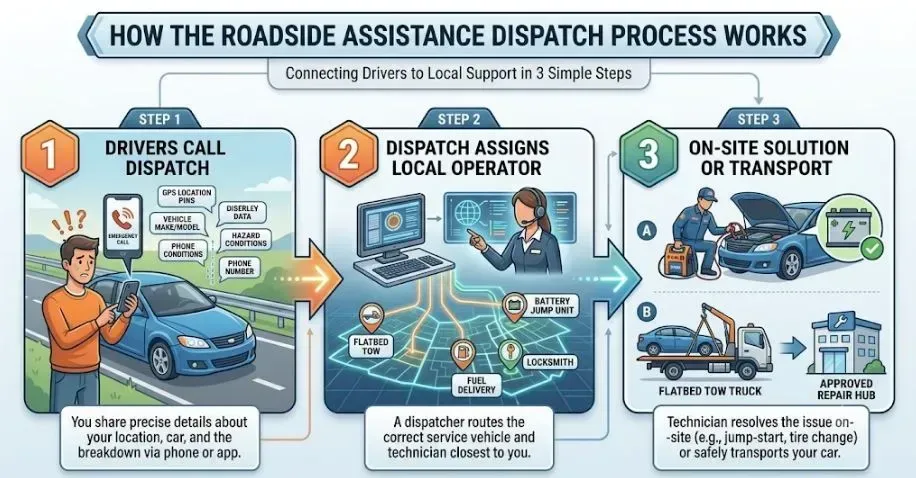
Roadside assistance process follow three main steps mentioned below.
Emergency Request & Triage: You contact your service provider via phone or mobile application, providing your exact GPS location, vehicle details, and a description of the problem.
Local Dispatch Assignment: The service provider routes your request to a nearby local operator equipped with the specific tools needed for your issue (eg, a flatbed tow truck or a battery jump-start unit).
On-Site Resolution or Transport: A service technician arrives at your location to either resolve the issue on the spot (such as unlocking a door or installing a spare tire) or safely tow your vehicle to a designated repair hub.
How Roadside Assistance Differs from Standard Auto Insurance?
Roadside assistance and standard auto insurance cover different needs. Roadside assistance helps when your vehicle breaks down or needs emergency help on the road. Standard auto insurance mainly covers financial losses from accidents, damage, theft, and liability.
The main differences between roadside assistance and standard auto insurance are summarized in the table below:
What Happens When You Call for Roadside Assistance?
To ensure a fast and effective response, roadside dispatchers require key operational data during your call. When contacting emergency roadside assistance services, be prepared to provide:
Exact Location Coordinates: Use your smartphone's map app to drop a precise pin or identify the nearest mile marker, intersection, or street landmark.
Vehicle Specifications: Share your vehicle's make, model, year, color, and drive-type (eg, All-Wheel Drive vs. Two-Wheel Drive, which determines whether a flatbed tow truck is required).
Safety Environment Context: Inform the dispatcher if you are stopped on a narrow highway shoulder, in a low-clearance parking garage, or in a high-traffic area so appropriate safety equipment can be sent.
The image below demonstrates the whole process to understand the roadside assistance process.
What Does Roadside Assitance Service Covers?
Roadside assistance service covers the most common mechanical and operational failures encountered by a vehicle on the road. A reliable roadside assistance covers the following:
Emergency Towing & Transport
If your vehicle suffers a major mechanical breakdown that cannot be fixed on the spot, roadside assistance provides towing service to transport your car to a nearby repair facility. Standard coverage typically includes:
Local towing up to a specified mileage limit (eg, 5 to 10 miles under basic plans, or up to 100+ miles under premium plans).
Transport to the nearest network-approved repair shop or dealer.
Specialized flatbed transport for All-Wheel Drive (AWD) vehicles or cars with severe suspension damage.
Battery Jump Start & On-Site Replacement
Cold weather, interior lights left on overnight, or age can cause a vehicle battery to fail without warning. Roadside technicians carry heavy-duty portable jump packs and voltage meters to test your battery health and safely jump-start your engine using surge-protected equipment. If the battery is completely dead and non-rechargeable, many providers offer on-site battery replacement.
Flat Tire Replacement & Punture Replacement
If you experience a flat or blown-out tire, a technician will arrive to safely remove the damaged wheel and install your vehicle's inflated spare tire. If you do not have a working spare tire or if multiple tires are damaged, the service will arrange a trip to a tire repair shop.
Fuel Delivery Service
Running out of gas on a busy road is embarrassing, but it is also hazardous. Fuel delivery services bring enough fuel (typically 2 gallons of gasoline or diesel) directly to your vehicle so you can safely drive to the nearest gas station.
Lockout & Key Fob Support
Locking your keys inside your vehicle or dealing with a dead key fob can leave you stranded. Roadside assistance dispatchers send locksmith tools and trained operators equipped with specialized wedge and reach tools to safely unlock your vehicle door without damaging the door frame or side-window seals.
When You Should Call for Roadside Assistance?
Determining whether an issue can be safely managed on your own or requires professional help depends on traffic conditions, physical safety, and equipment availability. Below are 11 situations where calling roadside support is the right choice.
1. Flat or Blown-Out Tire
Nails, screws, potholes, and worn-out tread can cause a tire to lose air rapidly or blow out entirely while driving. A flat tire often presents with a loud popping sound, heavy pulling to one side, active TPMS warning lights, or visible rubber shredding. While some motorist carry a spare wheel, changing a tire on a narrow highway shoulder or soft, uneven terrain poses extreme danger from passing traffic.
Requesting on-site tire replacement ensures a professional safely replaces the damaged wheel or dispatches a flatbed tow if the damage is severe. Reviewing roadside safety protocols helps assess your surroundings, but calling for emergency assistance while keeping your hazard lights activated remains the safest choice to avoid traffic hazards.
2. Weak or Dead Battery
Extreme temperatures, age, or leaving headlights on overnight can completely drain a vehicle battery without warning. When a battery fails, turning the ignition key typically produces a rapid clicking noise, dim dashboard lights, a slow engine crank, or complete electrical unresponsiveness. Attempting a DIY jump-start with basic cables carries the risk of reversing polarity and permanently frying your car's sensitive Engine Control Unit (ECU).
Contacting a service technician for a battery jump-start guarantees the use of voltage-regulated jump packs to safely revive your engine. Technicians can also perform on-site voltage diagnostics or arrange immediate battery replacement, keeping your modern auto-electrical system fully protected from destructive power surges.
3. Engine Overheating or No Fuel
Unexpected traffic delays, faulty fuel gauges, or misjudging distances between stations can leave your fuel tank completely empty. Symptoms of fuel depletion include engine hesitation during acceleration, a gas gauge remaining below the empty line, and a sudden, total loss of engine power. Walking along high-speed freeways carrying a gas can introduce severe pedestrian safety hazards.
Requesting emergency fuel delivery dispatches a technician directly to your stranded location with enough fuel to safely reach the nearest station. Remaining buckled inside your parked vehicle while awaiting delivery eliminates roadside accident risks and gets you back on your way quickly.
4. Locked Keys Inside
Modern auto-locking mechanisms and dead proximity key fob batteries frequently leave drivers locked out of their cars. Common scenarios involve keys visible on the passenger seat, a trunk auto-locking with the key fob inside, or dead fob batteries that fail to trigger manual override doors. Attempting to force entry using coat hangers or improvised tools risks shattering glass, bending metal door frames, and tearing weather stripping.
Reaching out to a roadside locksmith dispatches specialized entry tools and trained operators to unlock your car without causing cosmetic or structural damage. Professional lock-out dispatch safely resolves door, trunk, and key fob failures while preserving your vehicle's factory seals.
5. Engine Overheating & Oil Leak
Thermostat failures, radiator leaks, or broken water pumps can cause your engine temperature to spike dangerously high. Clear signs of overheating include steam streaming from under the hood, a temperature gauge entering the red zone, a sweet coolant odor, or active liquid puddles forming under the engine bay. Opening a hot radiator cap under these conditions can cause severe pressurized steam burns.
Arranging emergency flatbed transport is critical to prevent total engine block cracking and permanent internal damage. Professional towing ensures your vehicle is safely transported to a qualified mechanical repair workshop without running the compromised cooling system.
6. Mechanical & Transmission Failure
Internal driveline breakdowns occur when critical transmission components, clutches, or power steering modules fail without warning. Drivers will typically experience severe metal grinding noises, burning transmission fluid smells, or the engine revving loudly without forward acceleration. These major mechanical failures cannot be diagnosed or repaired on the shoulder of a road.
Summoning flatbed towing services immediately ensures your vehicle is loaded safely and transported to an approved repair facility. Professional transport prevents secondary gear grinding, protects your vehicle's drivetrain, and removes your car from dangerous traffic lanes.
7. Electrical Failure
suffer sudden total shutdowns. Key symptoms include a completely black dashboard display, flickering headlights, or simultaneous failure of power steering and windshield wiper modules during heavy rain. Because these systems are interconnected, roadside quick-fixes are rarely possible.
Booking diagnostic towing support allows your vehicle to be transported directly to a specialized automotive workshop. Technicians use computerized diagnostic scanning tools to locate blown fuses, faulty alternators, or compromised wiring harnesses safely off the road.
8. Minor Scene & Accident Recovery
Even minor vehicular collisions can leave a car structurally compromised or unsafe to drive legally. Common post-impact symptoms include deployed airbags, severe wheel misalignments, trailing fluid leaks, or crumpled body panels rubbing directly against the tires. Attempting to drive away from an accident scene risks secondary damage or complete loss of vehicle control.
Dispatching post-accident towing support ensures your vehicle is safely removed once emergency services clear the scene. Utilizing professional towing assistance guarantees compliance with local roadway clearance laws while preventing further mechanical damage to compromised components.
9. Stuck in Mud, Sand or Flood
Heavy snowstorms, muddy shoulders, and slick road surfaces can easily cause a vehicle to slide off the pavement. Trapped drivers experience wheels spinning without forward motion, axles becoming high-centered on snowbanks, or the vehicle tilting dangerously into a roadside ditch. Repeatedly rocking the vehicle back and forth to gain traction generates excessive heat and destroys the transmission.
Ordering a specialized winch-out recovery service brings heavy-duty winches and tow straps to pull your car back onto solid ground. Winch operators safely extract stuck vehicles without straining the drivetrain or damaging suspension mountings.
10. TPMS Dashboard Warnings
Tire Pressure Monitoring Systems (TPMS) alert drivers to dangerous drops in air pressure before visual flats occur. A flashing TPMS warning light, low-PSI digital reading, heavy steering feel, or unusual chassis vibration all signal rapid deflation. Continuing to drive on a tire suffering rapid air loss will destroy the internal tire carcass and permanently ruin the wheel rim.
Requesting immediate tire assistance allows a technician to locate punctures, inflate the tire, or mount your spare before rim damage occurs. Timely intervention saves expensive aluminum wheels and ensures you do not end up stranded on a high-speed highway.
11. Lack Of Safety Tools
Vehicle maintenance tasks often demand heavy specialized equipment, specific physical strength, and safe working conditions. Drivers frequently encounter missing lug wrenches, rusted spare tire carriers, seized lug nuts, or severe weather that makes outdoor repairs impossible. Attempting roadside maintenance without adequate tools or physical capability increases personal injury risks.
Dialing for professional roadside dispatch places the heavy, hazardous work into the hands of equipped, certified technicians. Professional support ensures repairs or vehicle transport are executed quickly using industrial-grade safety gear and proper traffic management protocols.
| Incident Type | DIY Feasibility | Primary Hazard / Risk | Recommended Action |
|---|---|---|---|
| Flat Tire (Home Driveway) | High | Low (Stable ground, no traffic) | Replace with spare using basic tools |
| Flat Tire (Highway Shoulder) | Extremely Low | Critical (High-speed traffic impact) | Call Roadside Assistance |
| Dead Battery (Quiet Parking Lot) | Moderate | Low (Requires verified cables) | Jump-start if proper gear is present |
| Dead Battery (Modern Hybrid/EV) | Extremely Low | High (Electrical system damage) | Call Roadside Assistance |
| Out of Gas (Local City Street) | Moderate | Low (Short walk to station) | Walk to station or call for fuel delivery |
| Out of Gas (High-Speed Freeway) | Extremely Low | Critical (Pedestrian roadside risk) | Call Roadside Assistance |
| Vehicle Stuck in Ditch/Mud | Low | High (Transmission overheating) | Call a Winch-Out Service |
The table above helps you decide whether to address an issue yourself or request emergency roadside assistance support.
When to Call 911 Emergency Services Instead of Roadside Assistance?
You should call 911 emergency services instead of roadside assistance in the following scenarios:
Active Traffic Danger: Your vehicle is stalled in a live lane of moving traffic on a high-speed highway or blind curve.
Injuries or Accidents: Anyone involved in the accident is injured, unresponsive, or in shock.
Fire or Smoke: You see flames, dark smoke, or smell heavy fuel spills near the engine bay.
Trapped Occupants: Children, pets, or individuals are locked inside a vehicle in extreme heat or cold conditions.
Crime or Threats: You feel unsafe or threatened by another party at the roadside scene.
What to Do While Waiting for Roadside Assistance?
Once you have requested assistance, take these five steps to ensure your personal safety while waiting for the dispatch operator:
Pull to Safety: If your vehicle is still mobile, pull completely off the travel lanes onto the right shoulder or turn into a brightly lit parking lot.
Increase Vehicle Visibility: Turn on your hazard lights (four-way flashers) immediately. If you have safety triangles or flares and conditions are safe, place them behind your vehicle.
Assess the Surroundings Before Exiting: If you are stopped on a high-speed highway or busy road, stay inside your vehicle with your seatbelt buckled. Exiting onto a live road shoulder is extremely dangerous.
Share Your Location: Send your live smartphone location pin to your dispatcher and a trusted family member. Connecting with local roadside dispatch and traffic-aware towingensures efficient tracking and faster arrival times.
Keep Your Phone Clear: Avoid using heavy battery-draining apps while waiting so your phone remains powered and available for the incoming driver's confirmation call.
Baptiste Towing and Transport offers 24/7 emergency roadside assistance sevices in Broward County. Call us anytime if you are stranded anywhere in Broward County and nearby areas.
FAQs About Roadside Assistance
What is the most common roadside assistance call?
The most common roadside assistance call is for a dead or discharged battery requiring a jump-start. Battery failures account for nearly half of all emergency service requests due to extreme weather temperatures, age, and unexpected electrical drains.
What does roadside assistance cover?
Roadside assistance covers standard roadside emergencies including towing, flat tire changes, battery jump-starts, lockout service, and emergency fuel delivery. Specific limits apply based on your provider plan, such as total towing mileage or fuel volume caps.
How long does roadside assistance takes to arrive?
Roadside assistance typically takes between 30 and 60 minutes to arrive after dispatch. Arrival times vary based on traffic conditions, weather severity, your geographic distance, and driver availability during peak hours.
Can roadside assistance open a locked car?
Yes, roadside assistance operators carry specialized tools to safely open locked vehicle doors without causing damage. If your vehicle uses high-security locks or specialized transponders, the dispatcher may route a certified automotive locksmith to your location.
What is the difference between towing and roadside assistance?
Roadside assistance encompasses a broad range of on-site emergency services designed to get your car running again, while towing is a specific service within roadside assistance used when a vehicle cannot be repaired on the spot.
What should I do if my car breakes in the garage?
If your car breaks down in a parking garage, notify the dispatcher of the clearance height before a truck is sent. Standard tow trucks cannot enter low-clearance structures, so a low-profile service vehicle or specialized wheel-lift unit must be assigned.
Baptiste Towing & Transport provides 24/7 towing, flatbed transport, vehicle recovery, and roadside assistance across Broward, Miami-Dade, and Palm Beach Counties.
COMPANY
FOLLOW US


© 2026. Baptiste Towing and Transport LLC. All Rights Reserved.