Call Now: (954)-479-2040 for 24/7 Towing


11 Common Myths About Towing Service Debunked
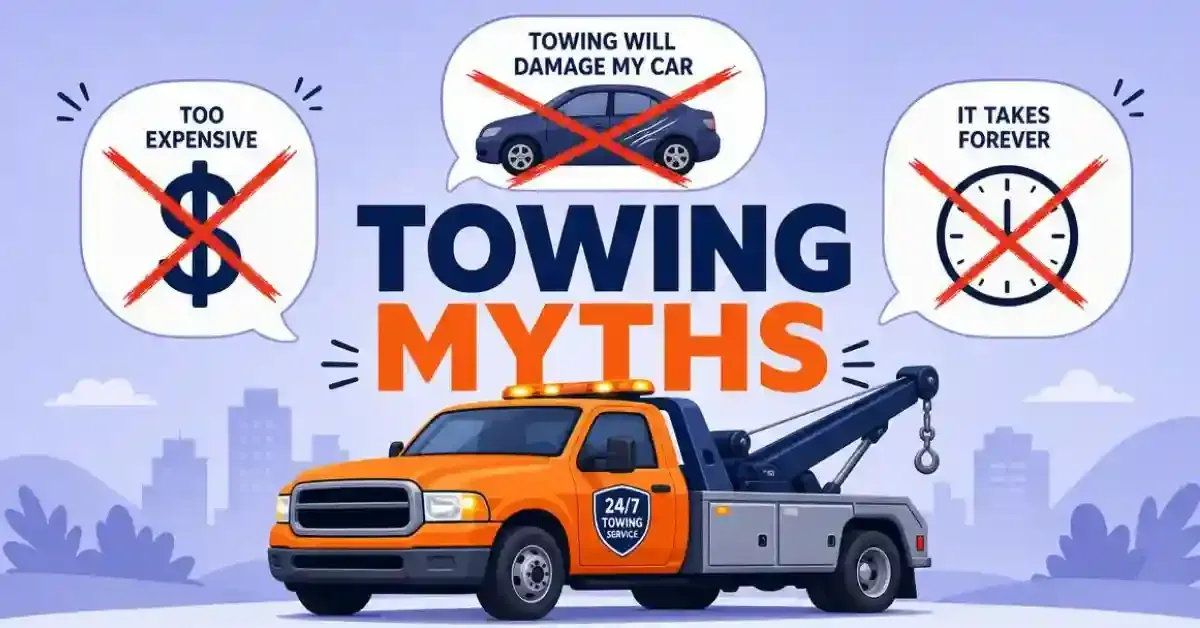
Myths and miconceptions about towing and roadside assitance are common if you have never come across these before. Some drivers assume a tow always damages a vehicle, or that every towing company charges the same inflated rate. Others believe age determines whether a car needs towing, or that automatic transmissions rule out certain trucks. A few assume roadside help takes too long, or that a new car never needs coverage at all. This guide debunks the most common towing myths.
What are The Common Towing Myths?
Below are the most common towing myths and misconceptions:
Towing Damages Your Vehicle
All Towing Companies Are the Same
Towing Is Expensive
You Can't Choose Your Own Towing Company
Towing Is Only Needed After an Accident
Only Old Cars Need to Be Towed
You Can't Tow a Vehicle with an Automatic Transmission
Roadside Assistance Takes Too Long to Arrive
You Don't Need Roadside Assistance If You Have a New Car
You Should Always Try to Fix the Problem Yourself First
Tow Truck Companies Only Offer Towing Services
Myth 1: Towing Damages Your Vehicle
Towing does not damage a vehicle when a company uses the correct truck type. A flatbed truck lifts the entire vehicle off the ground, removing contact between the wheels and the road surface.
Reality: A professional towing company protects your vehicle by matching the correct tow truck to its drivetrain, weight, ground clearance, and condition. Flatbed towing keeps all four wheels off the road, making it the preferred method for luxury vehicles, electric vehicles (EVs), motorcycles, low-clearance sports cars, and all-wheel-drive (AWD) models. Damage usually results from using the wrong equipment, improper loading, incorrect tie-down points, or inexperienced operators. Confirming the truck type before dispatch greatly reduces the risk of vehicle damage.
Myth 2: All Towing Companies Are Same
Towing companies vary in licensing, insurance, training, and equipment. Two companies quoting the same price can differ sharply in reliability and vehicle care.
Reality: Checking a company's license, insurance, and truck type answers this question directly, instead of assuming price alone reflects quality. Two companies quoting a similar price can differ sharply in reliability and vehicle care. A lower price sometimes signals missing insurance or unlicensed drivers, not simple competition.
Myth 3: Towing is Expensive
A common assumption holds that any tow costs a large, fixed amount, discouraging drivers from calling for help even when they need it.
Reality: Towing prices vary based on factors such as travel distance, vehicle size, service type, location, recovery difficulty, and time of day. Most companies charge a base hookup fee followed by mileage charges when applicable. Extra fees generally apply only for specialized recoveries, winching, accident recovery, heavy-duty towing, or after-hours service. Asking for an itemized quote before dispatch helps you understand exactly what you are paying for and avoids unexpected charges.
Myth 4: You Can't Choose Your Own Towing Company
After an accident, drivers sometimes assume they must use whichever towing company an insurance agent or police officer mentions first.
Reality: In most situations, you have the right to choose your preferred towing company. Insurance providers and law enforcement may recommend a company, but the final decision often remains yours unless specific local circumstances require otherwise. Choosing your own towing provider lets you compare reviews, pricing, response time, and destination instead of accepting the first available option.
Myth 5: Towing Is Only Needed After Accident
Many drivers associate towing exclusively with collisions, overlooking the range of situations that also require a tow truck.
Reality: Professional towing companies respond to many roadside emergencies besides accidents. Common calls include engine failure, transmission problems, overheating, flat tires, dead batteries, lockouts, fuel delivery, winch-outs, and vehicles that simply will not start. A tow truck provides safe transportation whenever driving the vehicle would create further mechanical damage or safety risks.
Myth 6: Only Old Cars Need Tow
A common assumption holds that new, well-maintained vehicles rarely need a tow, since mechanical failure feels tied to age.
Reality: Any vehicle can require roadside assistance regardless of age. New vehicles still experience battery failures, tire punctures, electrical faults, software issues, damaged wheels, and unexpected mechanical failures. Road hazards, weather conditions, and manufacturing defects affect new and older vehicles alike. Vehicle age alone does not determine whether towing becomes necessary.
Myth 7: You Cannot Tow Automatic Transmission Vehicle
Some drivers believe automatic transmission vehicles can't get towed safely at all, leading to unnecessary worry during a breakdown.
Reality: Automatic transmission vehicles can be transported safely when the correct towing method is used. Flatbed towing remains the safest option because it keeps every wheel off the road. Problems occur when certain drivetrain configurations are towed incorrectly using a wheel-lift truck. Professional towing companies determine the proper towing method based on the vehicle's drivetrain, manufacturer recommendations, and condition.
Myth 8: Roadside Assistance Takes Too Long to Arrive
Drivers sometimes hesitate to call for roadside help, assuming the wait will stretch far longer than it actually does.
Reality: Response time depends on the company's location, dispatcher availability, traffic conditions, weather, and current service demand. Local towing companies with trucks positioned throughout their service area often reach customers much faster than companies traveling from another city. Asking for an estimated arrival time before booking helps set clear expectations.
Myth 9: New Vehicles Do Not Require Roadside Assistance
New car buyers sometimes skip roadside assistance coverage, assuming a recent purchase removes the need entirely.
Reality: New vehicles remain vulnerable to common roadside incidents such as flat tires, dead batteries, lockouts, damaged wheels, empty fuel tanks, and electrical system failures. Even the latest vehicle cannot prevent punctures from road debris or accidental lockouts. Roadside assistance remains useful regardless of the vehicle's model year.
Myth 10: Try To Fix Your Vehicle Before Calling Tow Company
Some drivers feel pressure to attempt a repair on their own before calling for help, viewing a service call as a last resort.
Reality: Attempting a repair before calling for help sometimes causes more harm than the original problem. Changing a tire on a busy roadside, or working on an unfamiliar vehicle's battery, introduces real safety risk beyond the original issue.
Myth 11: Tow Truck Companies Only Offer Towing Service
Drivers sometimes call multiple providers separately, assuming a towing company handles only the tow itself and nothing else.
Reality: Most professional towing companies provide a full range of roadside assistance services. These commonly include battery jump starts, tire changes, lockout assistance, fuel delivery, winch-outs, accident recovery, motorcycle towing, flatbed transport, luxury vehicle transport, electric vehicle towing, and long-distance towing. Using one provider for multiple roadside services saves time and eliminates the need to contact separate companies during an emergency.
How to Choose A Reliable Local Towing Company?
Follow the steps below to choose a reliable towing company:
Step 1: Verify the towing company's license online.
Step 2: Read recent Google and Yelp reviews.
Step 3: Ask about pricing, arrival time, truck type, insurance, payment methods, and destination before booking.
Step 4: Confirm if the company provides the exact towing or roadside service your situation requires.
Step 5: Make sure the dispatched tow truck is suitable for your vehicle to prevent transport damage. For example, prefer a flatbed tow service for damage-free transportation.
Step 6: Request a complete written or verbal quote that includes all fees before the truck is dispatched.
Step 7: Verify the company carries the required license, liability insurance, and on-hook insurance to protect your vehicle.
Does towing cause damage to your vehicle?
Towing does not always cause vehicle damage. Damage results mainly from mismatched truck type, such as wheel-lift towing on an all-wheel-drive vehicle.
Baptiste Towing & Transport provides 24/7 towing, flatbed transport, vehicle recovery, and roadside assistance across Broward, Miami-Dade, and Palm Beach Counties.
Fort Lauderdale Location
Hollywood Location
Pompano Beach Location
Coconut Creek Location
COMPANY
Major Highways
I-95
I-75
I-595
SR 91
SR 869
© 2026. Baptiste Towing and Transport LLC. All Rights Reserved.