Call Now: (954)-479-2040 for 24/7 Towing



Jump Start vs Battery Replacement: Which to Consider
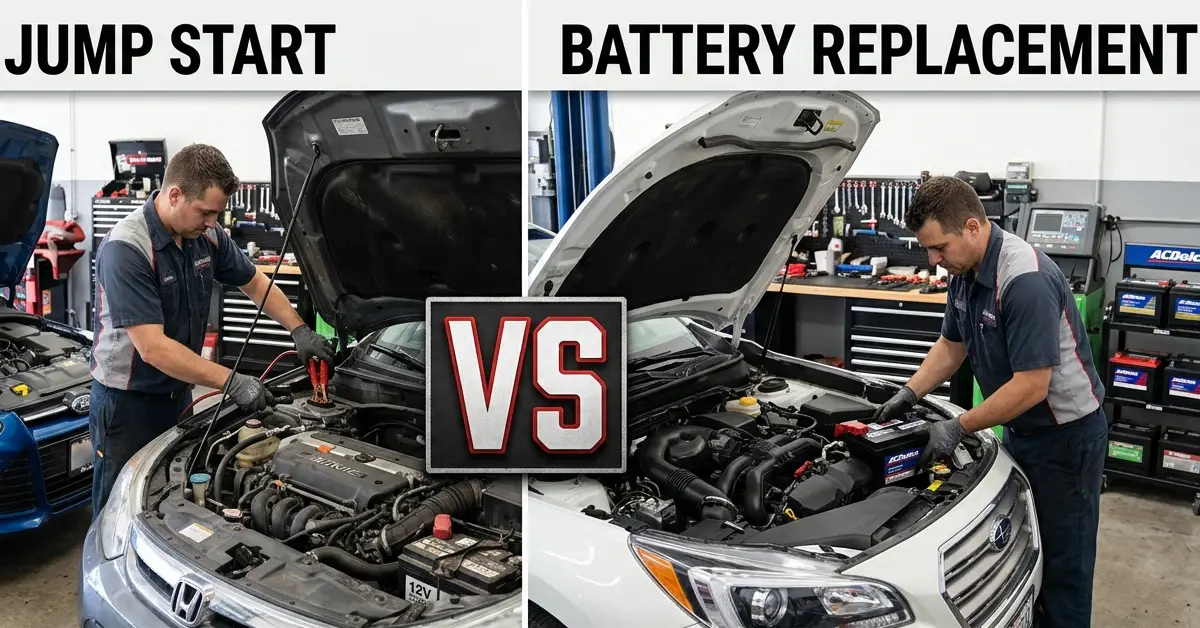
The main difference between a jump start and battery replacement is that a jump start helps your existing battery get the engine running, while battery replacement installs a new battery when the old one can no longer perform reliably.
A jump start is a temporary solution for a car battery that has lost its charge, while battery replacement is the long-term solution when the existing battery is worn out, damaged, or unable to hold a charge. If you left your headlights on or your car sat unused for several days, a jump start may be enough. However, if your battery repeatedly dies, struggles to start the engine, or fails a battery test, you may need a replacement.
The signs of a jump-start-only situation include a one-time drain, a battery within its 3 to 5 year service life, and normal starting after the jump. The signs of a battery replacement situation include slow cranking, repeated jump starts, and a battery at the end of its service life. The other causes of a no-start include alternator faults, starter motor faults, and corroded battery terminals.
What Is the Difference Between a Jump Start and Battery Replacement?
The difference between a jump start and battery replacement is the duration: a jump start supplies temporary power, while battery replacement installs a new battery by replacing the old one.
A jump start uses a donor vehicle with jumper cables, or a portable jump starter, to crank the engine of the car with the discharged battery. Once the engine runs, the alternator takes over power generation. The car battery receives no repair during a jump start.
Battery replacement removes the old car battery and installs a new battery of the correct type and size. The installer connects the terminals and secures the battery. Some vehicles require battery registration after installation, such as many BMW models.
The table below compares a jump start and battery replacement
| Features | Jump start | Battery replacement |
|---|---|---|
| Purpose | Starts a car with a discharged battery | Replaces a worn, damaged, or non-charging battery |
| Duration of effect | Temporary | Long-term, across a 3 to 5 year battery service life |
| Repairs the battery | No | Yes, by installing a new battery |
| Typical trigger | One-time drain, such as lights left on | Failed battery test, repeated jump starts, or physical damage |
| Service location | Roadside or driveway | Roadside (mobile service), garage, or shop |
How Do You Know If You Need a Jump Start or Battery Replacement?
You can often identify the likely problem by looking at how your car behaves when you turn the key or press the start button. However, symptoms alone cannot confirm battery condition, so testing is the most reliable way to distinguish a discharged battery from a failing one.
Signs Your Car Needs A Jump-Start
Your car may need a jump start rather than a new battery if:
You left the vehicle headlights or interior lights on. An accessory left running can drain an otherwise healthy battery.
The vehicle has been parked for a long time. A car that sits unused may lose charge gradually, especially if its battery is older or the vehicle has a small ongoing electrical drain.
The battery discharged after a one-time incident. If the battery was accidentally drained and passes a subsequent test, replacement may not be necessary.
The engine starts normally after a jump. This is encouraging, but it does not prove the battery is healthy. A battery test can help confirm whether it still holds sufficient charge.
The battery is relatively new and undamaged. A newer battery may simply need recharging, although a charging-system or electrical fault should be considered if the problem returns.
These signs indicate a temporary drain. A battery test confirms battery health after any jump start.
Signs Your Car Requires Battery Replacement
Your car battery may need replacement if you notice any of the following:
Repeated jump starts: You need a jump start several times over a short period, even after the battery has been recharged.
Slow engine cranking: The engine turns over more slowly than usual, particularly during starting.
An older battery: Many conventional car batteries last around three to five years, although climate, driving habits, battery type, and maintenance affect lifespan.
A battery that fails testing: A battery test indicates that it cannot deliver sufficient starting power or retain an adequate charge.
Physical damage: The battery case is swollen, cracked, or leaking. Do not attempt to jump-start a damaged battery; seek professional assistance.
Recurring low charge: The battery repeatedly becomes discharged despite normal use and adequate charging.
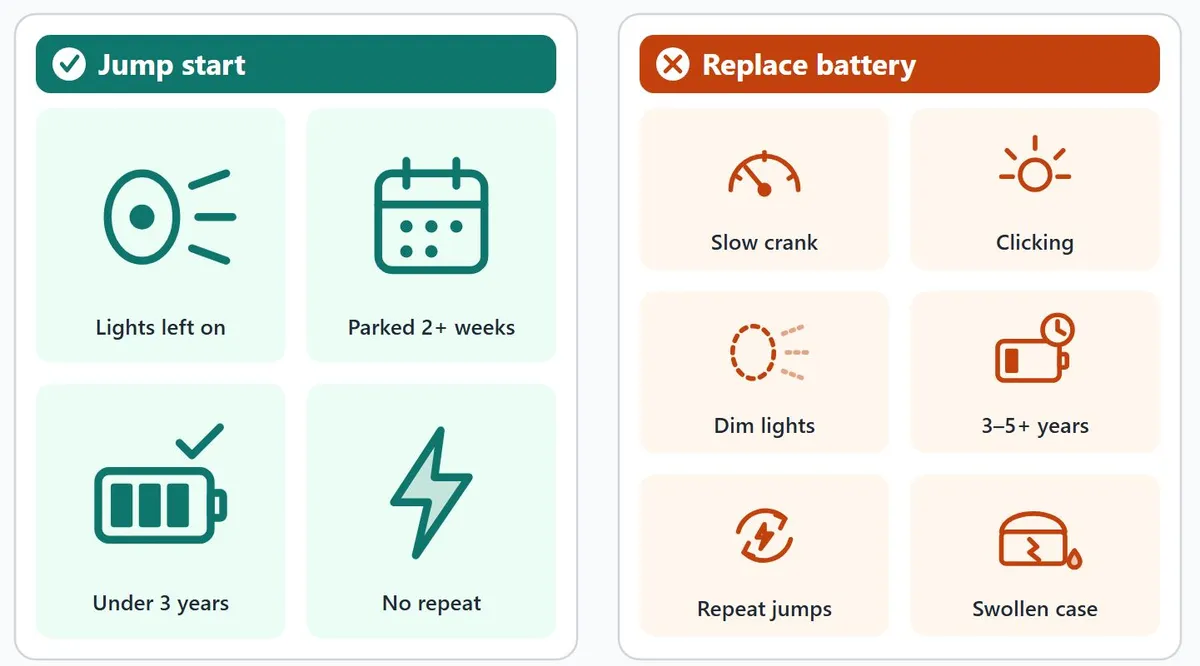
A failed battery test confirms replacement. A swollen, cracked, or leaking case requires immediate replacement and excludes a jump start.
Should You Replace Your Car Battery After a Jump Start?
No, you do not automatically need to replace your car battery after a jump start. If the battery was drained because you left the lights on or the vehicle sat unused, it may continue working normally after being properly recharged.
However, if the battery repeatedly loses charge, struggles to start the engine, or fails a battery test, replacement may be the better option.
After a jump start:
Check the starting response. Listen for slow cranking, repeated clicking, or unusual sounds.
Inspect the battery. Avoid jump-starting a swollen, cracked, or leaking battery.
Test battery health. Check its condition and starting capability.
Check the charging system. Investigate alternator faults or electrical drains if the problem returns.
Replace a failed battery. Choose one that meets your vehicle manufacturer's specifications.
How Long Will a Car Battery Last After a Jump Start?
A car battery can continue working for years after a jump start if it was healthy and only temporarily discharged. If the battery is nearing the end of its useful life, it may fail again soon, even if the engine starts after receiving a boost.
How long the battery lasts depends on its age, condition, charge level, the vehicle's charging system, and the reason it became discharged. Driving after a jump start may help recharge the battery if the alternator and charging system are working correctly. However, driving for a set period does not guarantee that a deeply discharged or deteriorated battery will recharge fully.
If the vehicle starts but struggles again later, have the battery and charging system tested instead of relying on repeated jump starts.
Can You Damage a Car Battery by Jump-Starting It?
Yes, incorrect jump-starting can damage electrical components and create safety risks. However, a correctly performed jump start using suitable equipment does not normally damage a healthy battery.
To reduce the risk:
Follow the manufacturer's instructions: Use the recommended jump-start procedure.
Use compatible equipment: Choose suitable cables or a jump starter.
Connect cables correctly: Follow the specified connection sequence and terminals.
Keep cables clear: Avoid moving engine components.
Avoid damaged batteries: Never jump-start a swollen, cracked, or leaking battery.
Stop if warning signs appear: Seek professional help if the battery overheats or emits a strong sulfur-like odor.
What is the Cost of Jump-Start Compared to Battery Replacement?
The cost of a jump start is generally lower than the total cost of replacing a car battery, but the final price depends on the service provider, location, vehicle, battery type, and whether you need additional diagnosis or repairs.
A jump start may be the more economical choice when the battery is healthy and the discharge was temporary. Battery replacement costs more upfront but may be the more reliable option when the battery has failed testing.
Before choosing either service, ask what the quoted price includes. For replacement, confirm whether the quote covers the battery, installation, disposal of the old battery, and any required electronic registration. For a jump start, ask whether battery testing is included.
Avoid replacing a battery based only on the fact that it needed a jump. Testing can help prevent unnecessary spending and identify problems that a new battery would not fix.
When Should You Call Roadside Assistance?
Call roadside assistance if your car will not start, you do not have safe jump-start equipment, or you are unsure whether the battery is damaged.
Professional roadside assistance like Baptiste Towing and Transport may help with:
Battery Diagnose
Battery Replacement
Towing Vehicle to Safe Location
The choice between a jump start and battery replacement depends on why your car will not start. A jump start may resolve a temporary loss of charge, while a replacement is appropriate when the battery is worn out, damaged, or unable to hold sufficient charge.
If your battery keeps dying, your vehicle starts slowly, or a jump start does not work, have the battery and charging system checked. A proper diagnosis can help you choose the right solution, avoid unnecessary costs, and get back on the road more confidently.
How do I know if I need a new battery or just a jump start?
You may need a jump start if the battery was temporarily drained, such as when the lights were left on. You may need a new battery if it repeatedly loses charge, cranks the engine slowly, is physically damaged, or fails a battery test. Testing the battery and charging system is the best way to confirm the cause.
Is a jump start cheaper than replacing a battery?
A jump-start service is generally less expensive upfront than purchasing and installing a new battery. However, if the battery has failed, repeated jump starts may not solve the problem. Compare the service price with the total replacement cost and confirm the battery's condition before deciding.
Can a car battery recharge itself after a jump start?
The vehicle's alternator can recharge the battery while the engine runs if the charging system is functioning correctly. However, a deeply discharged or failing battery may not recover fully through driving alone. A battery charger or professional testing may be needed.
What if my car won't start even with a new battery?
If your car still will not start with a new battery, the cause may be a faulty starter, alternator, poor electrical connection, damaged cable, or another vehicle problem. Call roadside assistance to diagnose the battery or tow your vehicle to a nearby auto shop for deep diagnostic.
Baptiste Towing & Transport provides 24/7 towing, flatbed transport, vehicle recovery, and roadside assistance across Broward, Miami-Dade, and Palm Beach Counties.
Fort Lauderdale Location
Hollywood Location
Pompano Beach Location
Coconut Creek Location
COMPANY
Major Highways
I-95
I-75
I-595
SR 91
SR 869
© 2026. Baptiste Towing and Transport LLC. All Rights Reserved.