Call Now: (954)-479-2040 for 24/7 Towing


Understanding How Tow Trucks Actually Work Behind the Scenes
A tow truck is a recovery vehicle that uses a hydraulic lifting or loading system to move disabled, damaged, or illegally parked vehicles. A tow truck works through six stages: dispatch, truck selection, travel, on-scene assessment, loading, and transport. The towing process depends on three components: a diesel or gasoline engine, a power take-off (PTO) unit, and a heavy-duty hydraulic system. The hydraulic system drives specialized winches, flatbed tilting, and wheel-lift arms.
A tow truck operator arrives at the scene, connects the vehicle to the truck, lifts or loads the vehicle, secures the vehicle, and transports the vehicle to a repair shop or storage yard. Equipment, operator training, vehicle dimensions, and response time determine how safely each tow is completed.
How Tow Trucks Actually Work Behind the Scenes?
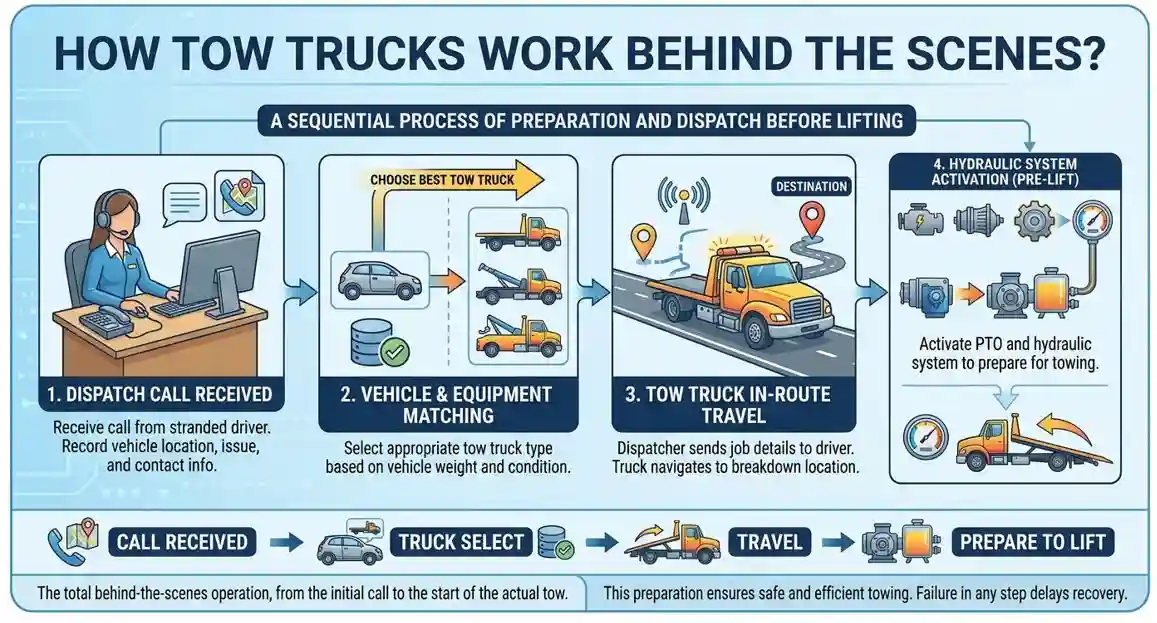
Tow trucks work behind the scenes through a sequence of dispatching, equipment matching, travel, and hydraulic power delivery before the first wheel is lifted. The towing process begins when a stranded driver calls a towing company, and the process ends when the towed vehicle reaches a drop-off location.
The following are the 3 main behind-the-scenes steps of a tow truck operation:
Receive the call and record the driver's details at the dispatch desk.
Match the vehicle with the correct tow truck type and equipment.
Drive the tow truck to the breakdown location.
Dispatching
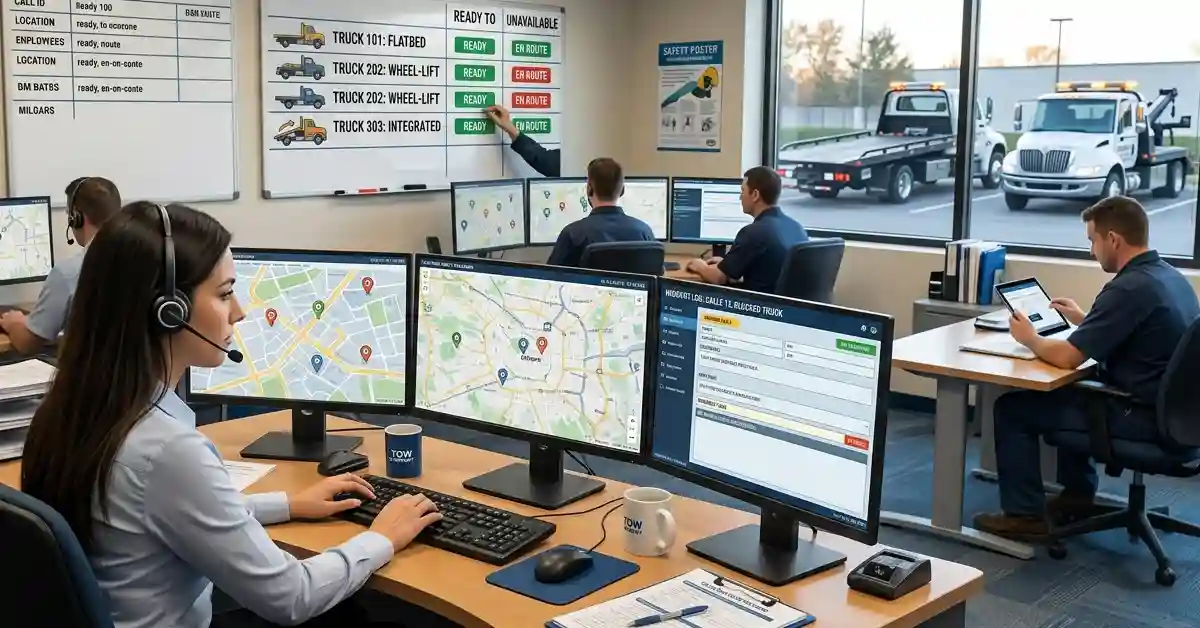
Dispatching is the process in which a towing company receives a call, records the details, and assigns a tow truck. The dispatcher asks for the vehicle location, vehicle type, and breakdown condition. Location determines the nearest available truck. Vehicle type determines the right equipment. A dispatcher asks whether the vehicle is a sedan, an SUV, a motorcycle, or a box truck, and whether the vehicle is stuck, crashed, or mechanically disabled. Dispatchers also ask whether the vehicle is in a parking garage, on a highway shoulder, or in a ditch, since each position requires different equipment.
Selecting Right Tow Truck
Tow truck selection depends on vehicle weight, drivetrain, vehicle condition, fuel type, and location. Vehicle weight separates light-duty trucks from heavy-duty trucks. Drivetrain separates trucks that lift two wheels from trucks that carry all four wheels. A flatbed tow truck carries all-wheel-drive (AWD) and four-wheel-drive (4WD) vehicles, because lifting only two wheels damages the drivetrain. A flatbed also carries electric vehicles and luxury vehicles, since low ground clearance and sensitive components require a level, off-the-ground transport. A wheel-lift tow truck suits front-wheel-drive and rear-wheel-drive cars in short urban tows and tight parking spaces.
Drive Tow Truck to Location
Tow trucks move to the location by following the fastest route that dispatch software or the driver selects. The operator confirms the address, vehicle type, and hazards, such as heavy traffic or a highway shoulder, before leaving the yard. Operators carry wheel chocks, safety chains, straps, warning lights, and cones on every call, which allows immediate setup on arrival.
How Does A Tow Truck Get Its Power?
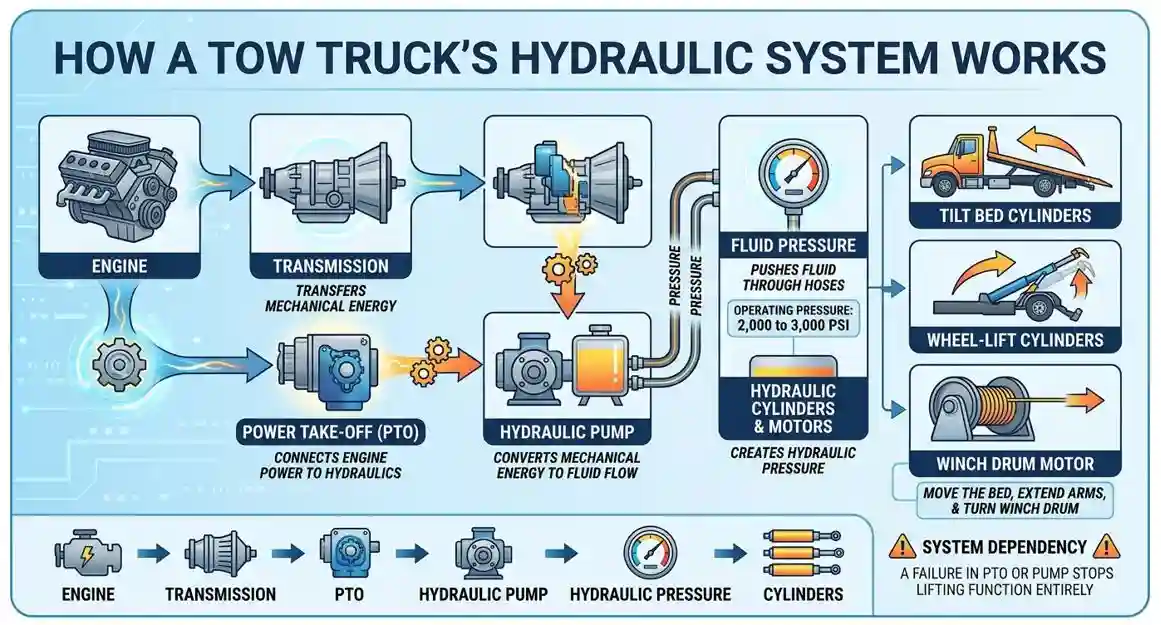
A tow truck gets its power from the engine, which transfers energy through the transmission to the PTO, and the PTO drives the hydraulic pump. The hydraulic pump pushes fluid through hoses and creates hydraulic pressure. Hydraulic pressure moves the cylinders that tilt the bed, extend the wheel-lift arms, and turn the winch drum. Most tow truck hydraulic systems operate at roughly 2,000 to 3,000 psi, depending on the model and the lifting task.
The power flow follows this sequence: engine, transmission, PTO, hydraulic pump, hydraulic pressure, and cylinders. Each component depends on the previous component, so a failure in the PTO or pump stops the lifting function entirely.
What Is Power Take-Off (PTO) in a Tow Truck?
A power take-off (PTO) is a transmission-mounted gear mechanism that connects the truck's engine power to the hydraulic pump. The PTO converts engine rotation into hydraulic fluid pressure. Without the PTO, the hydraulic pump does not run, and the arms, bed, and winch do not move. The operator engages the PTO with a switch or lever in the cab, usually before arriving at the scene or right before loading begins. Engaging the PTO connects the pump, builds fluid pressure, and delivers controlled lifting force to the arms and the winch.
How Tow Truck Work On-Scene?
Tow trucks work on-scene through 3 phases: assessment, preparation, and towing. The operator reviews the vehicle and the surroundings, protects the area, and then performs the tow. The phases follow the same order on every call, whether the vehicle is a compact car or a loaded semi-truck.
The following are the 3 phases of an on-scene tow operation:
Assess the wreckage, the vehicle position, and the road hazards.
Prepare the vehicle, the equipment, and the scene for the tow.
Tow the vehicle with the correct lifting or loading method.
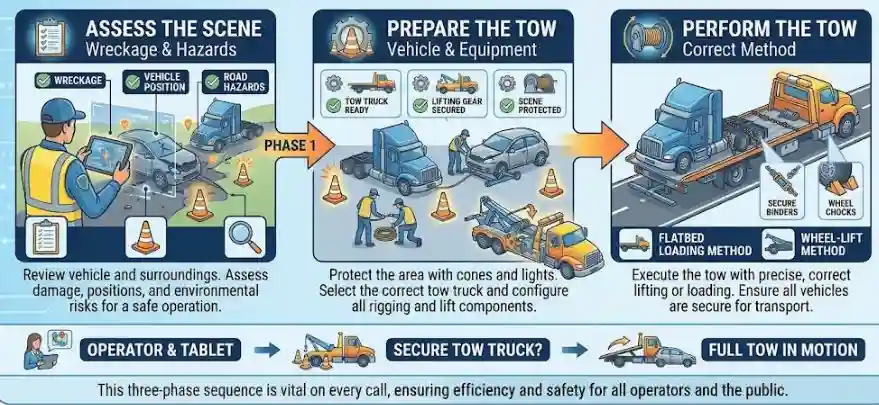
On-Scene Assessment
During on-scene assessment, a tow truck operator inspects the wreckage, locates the factory lift points, and chooses a method that prevents further damage. The operator checks 4 conditions: vehicle position, damage level, drivetrain type, and ground surface. Factory lift points and tow hooks are the only safe attachment locations, because chains attached to suspension parts or body panels cause new damage. An operator also notices fluid leaks, a locked steering wheel, a parking brake that will not release, and a damaged tire, since each condition changes the loading method.
Prepare for Towing
Preparation for towing includes securing the scene, placing the vehicle in neutral, releasing the parking brake, and positioning the tow truck. The operator places cones, activates warning lights, and parks the truck in line with the vehicle to be towed. The operator also removes loose parts, checks tire pressure, and uses dollies or skates if the wheels are locked or the vehicle is not rolling.
Towing & Transportation
Once everything is in place, the operator lifts the vehicle and transports it to the final destination.
How long does tow truck takes to arrive at the scene?
A tow truck typically arrives within 30 to 60 minutes after the call. Urban calls average 30 minutes or less, while rural calls take 60 minutes or more. Five factors affect the arrival time: distance from the nearest truck, traffic conditions, weather, time of day, and the type of truck requested. Heavy-duty recovery trucks take longer than light-duty trucks, because fewer heavy-duty trucks operate in each area and the truck must travel with additional equipment. Storms and rush hour add 15 to 30 minutes to a typical response.
How Does the Actual Towing Process Work?
The actual towing process begins after the on-scene assessment is completed and the tow truck is positioned to move the damaged vehicle. The operator attaches the vehicle, lifts or loads the vehicle, secures the vehicle, and transports the vehicle to the destination. Five crucial steps complete the towing process.
The following are the 5 crucial steps of the actual towing process:
Tilt the bed with the hydraulic system and lower the ramp to the correct ramp angle, which is shallower for low-clearance vehicles.
Attach the winch cable or hook to the factory tow points.
Pull the vehicle onto the bed, or lift one end with the wheel-lift arms.
Secure the vehicle with straps, chains, and wheel restraints at 4 contact points.
Transport the vehicle to the drop-off location and complete the documentation follow-up, including the signed release form and the invoice.
How Does A Flatbed Tow Truck Operate?
A flatbed tow truck operates by tilting and sliding a hydraulic bed backward to form a ramp, so the vehicle is winched onto the bed. The bed measures 18 to 22 feet in most light-duty trucks. A winch rated between 8,000 and 12,000 pounds pulls the vehicle up the ramp. The hydraulic bed then returns to a level position, and all 4 wheels stay off the ground during transport.
How Does A Wheel-Lift Tow Truck Operate?
A wheel-lift tow truck operates by extending hydraulic arms under the front or rear tires and lifting one end of the vehicle off the ground. The arms cradle the tires, and a hydraulic cylinder raises the vehicle. The other 2 wheels remain on the road during transport. Wheel-lift trucks are shorter and quicker to hook up than flatbeds, which makes wheel-lift trucks efficient for city towing and repossessions.
How Do Heavy-Duty Tow Trucks Operate?
Heavy-duty tow trucks work by using rotators, booms, outriggers, and multi-line winches to recover vehicles weighing more than 26,000 pounds. A rotator is a recovery truck with a 360-degree rotating boom, and rotators lift 50 to 100 tons. Outriggers extend to the ground and stabilize the truck during the lift. Multi-line winches distribute the load across several cables, which controls the pull on overturned buses, tractor-trailers, and construction equipment.
Are Tow Truck Drivers Professionally Trained?
Yes, tow truck drivers are professionally trained. Towing companies train operators on hydraulic equipment, winching, load securement, and roadside safety. The Towing and Recovery Association of America (TRAA) offers the National Driver Certification Program (NDCP), which certifies operators at levels such as light-duty and heavy-duty towing. WreckMaster is another recognized certification for recovery techniques. Many operators also complete first aid and traffic incident management training.
What are Requirements to Become a Tow Truck Driver?
The requirements to become a tow truck driver include a minimum age of 18 to 21, a valid driver's license, and a clean driving record. Age requirements vary by state and employer. A commercial driver's license (CDL) is required for trucks above 26,001 pounds gross vehicle weight rating. Employers also require a background check, a drug test, and on-the-job training, which ranges from several weeks to several months.
Baptiste Towing & Transport provides 24/7 towing, flatbed transport, vehicle recovery, and roadside assistance across Broward, Miami-Dade, and Palm Beach Counties.
Fort Lauderdale Location
Hollywood Location
Pompano Beach Location
Coconut Creek Location
COMPANY
Major Highways
I-95
I-75
I-595
SR 91
SR 869
© 2026. Baptiste Towing and Transport LLC. All Rights Reserved.