How to Get Your Vehicle Out of Mud or a Ditch (5 Easy Steps)
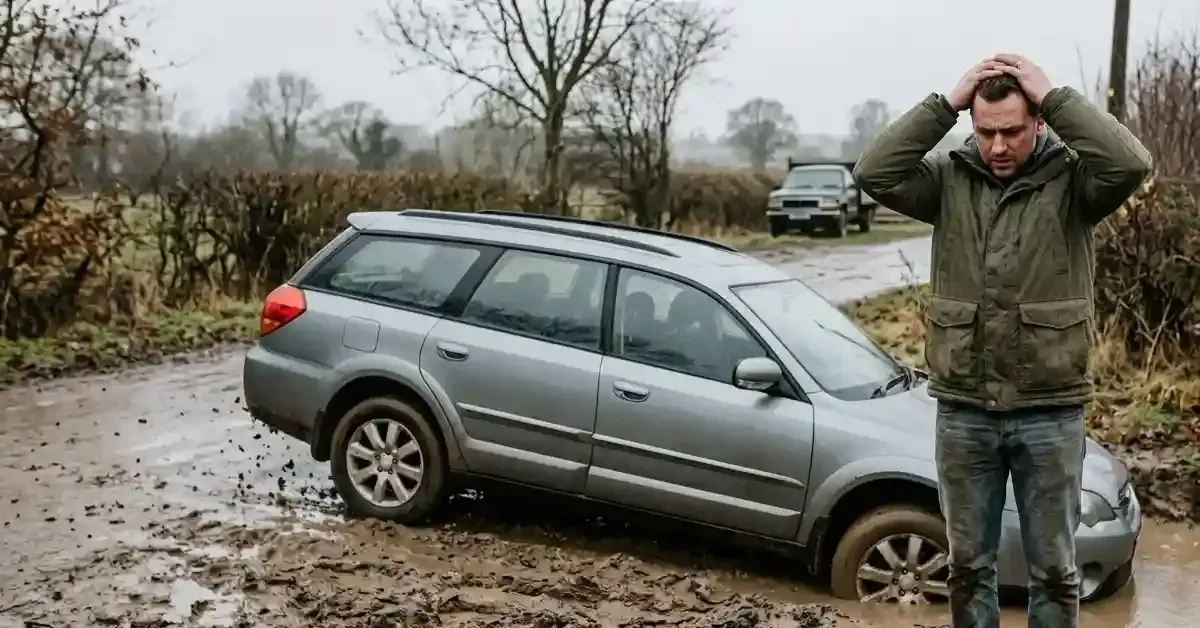
If your car slips into a ditch or bogs down in deep mud, stop accelerating immediately. Spinning your wheels digs the tires deeper into wet soil and risks damaging your transmission. Turn on hazard lights, pull your parking brake, and assess the vehicle's tilt, ground clearance, and surrounding space before attempting to drive out. To get your car out of mud or ditch, start by clearing space around the tires, shifting into a higher gear, wedging solid material under the drive wheels, easing tire pressure down slightly, and rocking the vehicle between Reverse and Drive each address a different part of the same traction problem.
Muddy driving conditions turn a stranded vehicle situation into a safety concern fast, especially on a roadside shoulder or a low-visibility stretch of road. Assess the situation fully before touching the gas pedal again: check how deep each tire sits, whether the frame contacts the ground, and whether other traffic can see your hazard lights clearly.
How to Get Your Vehicle Out of Mud or Ditch (Step-by-Step Recovery)
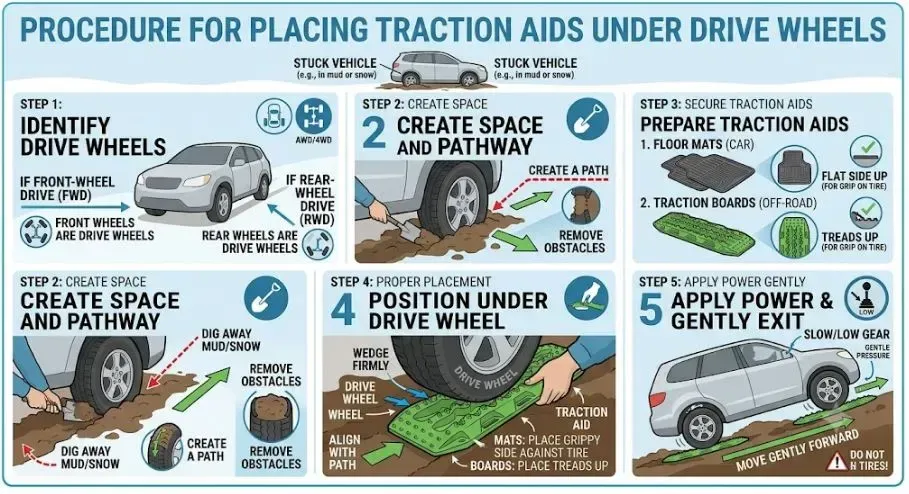
Before calling a recovery truck, execute the following 5-step traction sequence to free your vehicle without causing mechanical damage. The diagram below illustrates all the important steps to move a vehicle out of mud, sand, or ditch.
Step 1: Give Yourself Room to Move
Clear mud, slush, or debris away from the front and rear of your drive tires. This creates a flat, unobstructed runway that gives the vehicle room to build momentum in either direction.
Use a shovel, a tire iron, or even a sturdy stick if no tool is available. Dig a shallow path extending about 2 feet in the direction you plan to move, angled slightly downward if the terrain allows it, since a gentle downhill path reduces the effort needed to gain momentum.
Check under the vehicle at the same time. Mud packed against the undercarriage or wheel wells adds resistance and weight, working against every step that follows.
Step 2: Try Pulling Away in High Gear
Start in 2nd gear, or engage "Snow/Ice Mode" if your automatic transmission offers it. A higher gear reduces wheel torque, which helps tires grip the slippery surface instead of spinning freely against it.
First gear delivers maximum torque to the wheels, which sounds helpful but works against you on a low-traction surface. That extra torque overwhelms the tire's grip almost instantly, causing the wheel to spin in place rather than pull the vehicle forward.
Manual transmission drivers should ease off the clutch slowly in 2nd gear, applying steady, light throttle rather than a sudden push. Automatic transmission drivers without a dedicated snow mode can often get a similar effect by manually selecting a higher gear through the shifter, if the vehicle allows it.
Step 3: Add Traction Under Tires
Position traction boards, floor mats, cardboard, or branches directly under the edge of the drive wheels. This gives the tire tread something solid to grip, instead of loose mud or wet soil. Many drivers put cat litter under the stuck tires to gain more traction. Always keep a bag of cat litter in your trunk if you frequently drive in an area with wet mud, sand, or deep ditches.
Identify the drive wheels first, since traction materials work only when placed under the wheels actually receiving engine power. Front-wheel-drive vehicles need materials under the front tires, rear-wheel-drive vehicles need them under the rear tires, and all-wheel-drive vehicles benefit from materials under all 4.
Push each item as far under the tire as safely possible, ideally touching the point where the tire meets the ground. A board or mat sitting just in front of the tire, rather than partially beneath it, provides far less grip once the wheel starts turning.
Step 4: Lower the Tire Pressure
Reduce tire pressure by 5 to 10 PSI. This widens the tire's footprint against the ground, spreading weight over a larger surface area and improving grip.
A wider footprint distributes the vehicle's weight over more surface area, reducing how deeply the tire sinks into soft ground. This same principle applies across mud, snow, and sand, though the ideal pressure reduction varies slightly by surface type.
Keep a portable tire inflator in the vehicle if this step becomes necessary, since driving on underinflated tires for an extended distance afterward risks damage to the tire's sidewall. Refill tires to normal pressure as soon as the vehicle reaches a paved road.
Step 5: Rock The Vehicle Gently
Shift rhythmically between Reverse and Drive to build kinetic momentum. Avoid riding the clutch or holding the accelerator down during this process, since both actions generate excess heat in the transmission.
Come to a complete stop before each gear change, rather than shifting while the vehicle is still moving. Shifting mid-motion strains the transmission and reduces the built-up momentum this technique depends on.
Apply light, steady throttle in each direction, building slightly more distance with every rocking cycle. Most vehicles break free within 3 to 5 cycles, if the surface allows any traction at all. If no progress shows after that point, stop and move to traction materials or tire pressure adjustment instead of continuing to rock the vehicle.
What Not to Do If Your Vehicle is Stuck in Mud, Sand, or Ditch?
When a car is stuck in mud, sand, or ditch, do not:
Accelerate too hard: High RPMs cause tires to act like shovels, burying the vehicle up to its frame and overheating transmission fluid in the process.
Stop moving once you gain momentum: Once the car breaks free, maintain steady momentum until reaching a dry, paved surface. Stopping midway allows the vehicle to sink right back into the mud.
Loose your cool: Staying calm prevents erratic driving maneuvers that damage clutches, tires, or steering linkages during the recovery attempt.
What Causes A Vehicle to Get Stuck in Mud?
A vehicle gets stuck in mud when its tires lose contact with a solid surface, spinning against soft, low-friction ground instead of gripping it. Several conditions make a vehicle stuck in mud, the most common ones are mentioned below.
Saturated soil — Heavy rain or melting snow softens ground until it can't support the vehicle's weight, letting tires sink below the surface.
Excessive wheel spin — Applying too much throttle causes tires to dig downward rather than pull forward, turning a shallow patch of mud into a deep trench.
Low ground clearance — Vehicles sitting closer to the ground make contact with mud or ruts sooner, increasing drag on the undercarriage.
Worn tire tread — Tires with reduced tread depth grip less effectively on wet or loose surfaces, making initial traction harder to establish.
Uneven weight distribution — A heavily loaded trunk or one side of the vehicle carrying more weight shifts pressure unevenly across the tires, reducing grip on the lighter side.
Standing water in the ditch — Water mixed into soil breaks down its structure further, turning otherwise firm ground into an unstable, sinking surface.
Sudden braking or steering on soft ground — Abrupt movements disrupt whatever grip the tires had, often pushing a vehicle from a recoverable position into a fully stuck one.
Unlucky To Move Your Car Out of Mud? Call Baptiste Towing for Winch-Out
Maybe this is not your lucky day left stranded in mud or a ditch. When none of the above steps work for you or if your vehcile is resting at an angle above 30°, it's time to call a reliable winch-out service company such as Baptiste Towing to get you out of this situation. A winch-out service uses a vehicle-mounted cable system to extract a car from a ditch or deep mud without further mechanical stress, handling situations self-recovery methods can't safely resolve. For a breakdown unrelated to mud or terrain, roadside assistance covers winter towing and emergency dispatch directly.
FAQs About Car Stuck in Mud or Ditch
Can getting stuck in mud damages my car?
Yes, getting stuck in mud damages your car if your accelerate too much to get out of this situation. Excessive tire spinning causes extreme heat in automatic transmissions, damages differential gears, misaligns steering systems, and packs mud into brakes and radiator fins.
Should I use sand or salt to get my vehicle out of mud?
Yes, you can use sand as it provides immediate grit and physical traction on wet mud. Salt melts ice and snow but offers no friction benefit on pure mud, and can accelerate underbody corrosion.
Can the tire pressure help with car stuck in mud?
Yes, lowering tire pressure by 5 to 10 PSI widens the tire's footprint against the ground, spreading the vehicle's weight over a larger surface area and reducing how deeply the tire sinks into soft mud.
What to do if my car gets stuck in snow instead of mud?
If you car gets stuck in snow instead of mud, the Traction principles stay similar across surfaces, though snow requires clearing underbody drag and applying salt or sand for thermal melting. Deep sand requires significant tire deflation, down to around 15 PSI, to help the tires float over loose grains instead of digging in.
How to get out an electric vehicle stuck in mud?
To free an EV stuck in mud, use a Mud or Off-Road drive mode if available, apply light throttle to avoid instant wheel spin, add traction material under the drive wheels, lower tire pressure by 5 to 10 PSI, and rock gently between Reverse and Drive. If stuck in water or unmovable after several tries, call a winch-out service instead.
How to move out an automatic car stuck in mud?
To free an automatic car stuck in mud, shift into 2nd gear or Snow/Ice mode to reduce wheel torque, clear space around the tires, add traction material under the drive wheels, lower tire pressure by 5 to 10 PSI, and rock gently between Reverse and Drive with light, steady throttle. Avoid holding the accelerator down or riding the brake, since both generate excess transmission heat. If the vehicle shows no progress after several tries, stop and call a winch-out service instead.
Can I use household items to gain traction to get my vehice out of wet mud or ditch?
Yes, household items can provide effective traction in a mud or ditch situation, when placed correctly under the drive wheels. Carpet strips, kitty litter, gravel, floor mats, and wooden boards all work as makeshift traction aids to get your vehicle out of mud or ditch.
Baptiste Towing & Transport provides 24/7 towing, flatbed transport, vehicle recovery, and roadside assistance across Broward, Miami-Dade, and Palm Beach Counties.
COMPANY
FOLLOW US


© 2026. Baptiste Towing and Transport LLC. All Rights Reserved.